A reliable computer system must be able to cope with the failure of one or more of its components.
Lamport, Shostak, and Pease, The Byzantine Generals Problem (1982)
2.1 Learning objectives
By the end of this chapter the reader should be able to:
State the double-spend problem precisely, and explain why a signature scheme alone cannot solve it.
State the Byzantine Generals problem and derive the \(n \geq 3f+1\) bound for classical Byzantine agreement.
Describe state-machine replication as the abstraction that both permissioned BFT and Nakamoto consensus implement.
Explain why open membership defeats naive identity-based voting (the Sybil attack), and why identity cannot be assumed as a primitive.
Explain Nakamoto’s substitution of probabilistic agreement, weighted by a scarce resource, for the deterministic agreement of classical BFT.
Judge whether a given multi-party data problem calls for permissioned BFT, a permissionless chain, or neither.
2.2 Orientation
We begin with a problem in the daily conduct of multi-site clinical research. Consider a phase III trial run jointly across several hospitals. Each site enrols participants, assigns them to treatment arms by randomisation, and records outcome events as they occur. Each site keeps its own copy of a shared log of these events, and no single site is trusted to serve as the sole custodian of the record. Some time later a regulator, or an independent data-monitoring board, audits the trial and must be able to reconstruct one ordered, tamper-evident history of what happened and when. We shall refer to this arrangement throughout the book as the trial ledger, and it is the running case study against which the machinery of the following chapters is to be measured.
The difficulty is not that any one hospital cannot keep good records. The difficulty is that the several copies must agree, and that they must be shown to agree to a party who trusts none of the sites individually. To see where the difficulty is sharpest, consider three ways in which the arrangement can fail.
The first failure is a conflict of order. The same participant, or equivalently the same randomisation slot, may be claimed at two sites at once: site 1 records that subject 0041 was enrolled and randomised to the active arm at 09:14, while site 2 records the same subject, or the same slot, enrolled one minute later. Which entry is the true one? A digital signature on each entry authenticates who wrote it, and proves the entry was not altered after signing, but a signature cannot order two conflicting entries in time, nor decide which of the two the trial ought to honour. In the vocabulary of digital cash, where the problem was first studied and where we shall meet it below, this is the double-spend problem. In the trial ledger it is the problem of double enrolment.
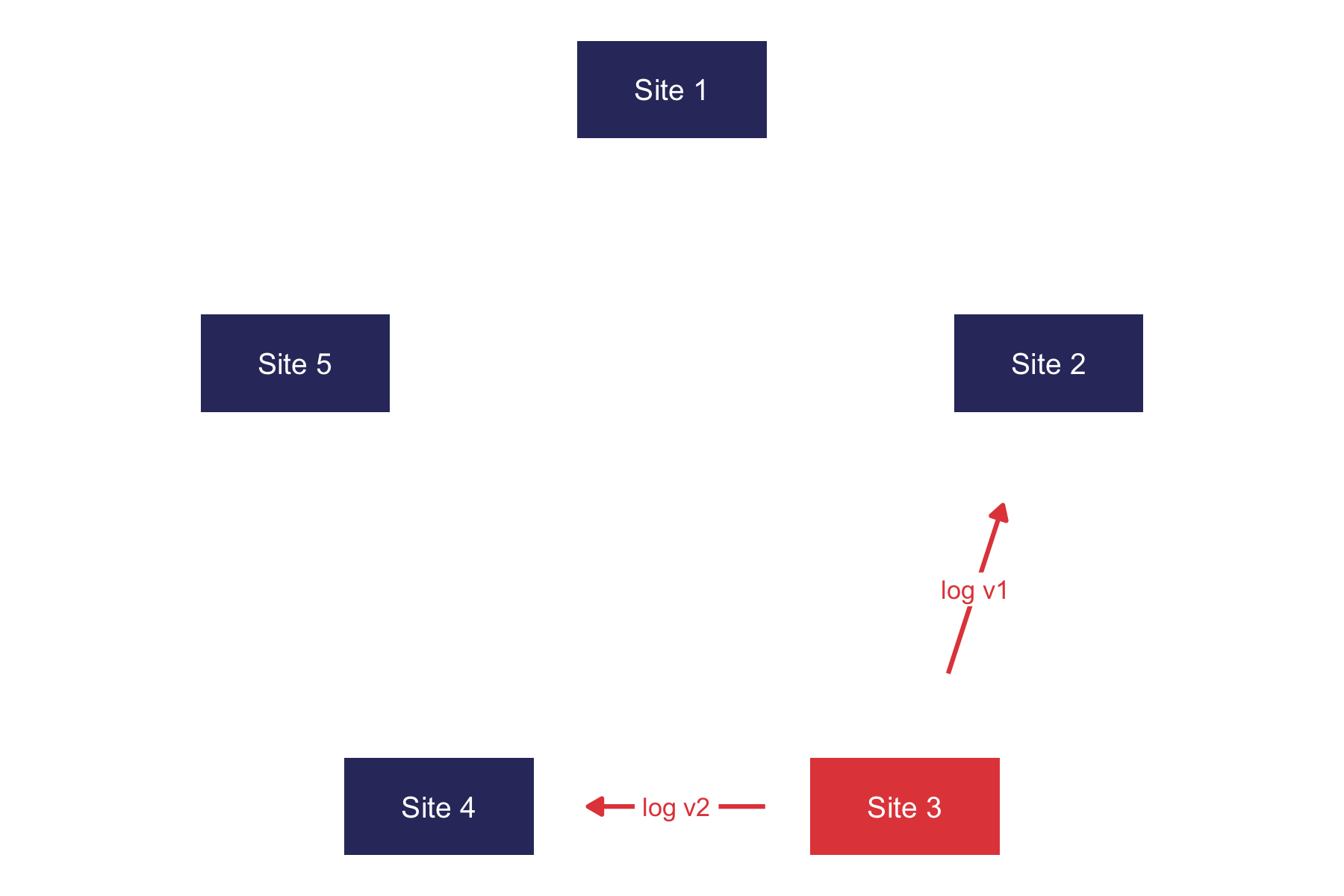
The second failure is adversarial. Suppose one hospital’s data server is compromised, or merely misconfigured, and sends one version of its log to the regulator and a conflicting version to a second site. The remaining participants are honest, yet they now hold mutually inconsistent records, and no honest party can tell, from its own copy alone, which sites have been told what. Agreement among parties of whom some unknown subset may send conflicting messages to different recipients is the Byzantine Generals problem, posed by Lamport, Shostak and Pease (Lamport et al., 1982), the computer scientists who in 1982 gave the problem its now-standard formulation, and it is the abstract core of this chapter.
The third failure appears only once membership is opened. Suppose that in place of a fixed consortium of named hospitals we operate an open disease registry that accepts case reports from anyone, and that we propose to settle disputes by some form of majority vote among reporters. Nothing then prevents a single actor from registering under a thousand invented identities and voting a thousand times, so that fabricated identities swamp the honest reports. This is the Sybil attack, and it is the reason that open-membership agreement is a genuinely harder problem than the fixed-consortium case.
The three failures line up one to one with three classical problems, and it is worth fixing that correspondence before we develop each in turn. Table 2.1 gives the map, together with the place in the book where each is treated in full.
Table 2.1: The three ways the trial ledger can fail, each an instance of a classical problem with a known treatment
These three failures motivate the chapter, but we should state plainly at the outset where the argument is going to lead. When the parties are a fixed, named, contractually accountable consortium, as the trial hospitals are, the problem is the classical one of agreement among known participants, solved by the permissioned protocols we present below, and in a great many such cases even that machinery is more than the problem requires: a single signed, append-only database with an audit log, maintained by one trusted operator, would serve. The permissionless machinery of the later chapters answers a different and harder trust problem, that of the open registry with no accountable membership at all. We shall be candid about this distinction wherever it arises, since reaching for the permissionless tool when the parties are in fact known and few is a design error, and one this book is written in part to help the reader avoid.
NoteThe vocabulary of this chapter
Several terms recur throughout the chapter. We define them here, in plain form, and use them consistently thereafter. Each receives a fuller treatment in the section that develops it.
Byzantine fault, Byzantine agreement. A Byzantine fault is a failure in which a participant may behave arbitrarily, and even dishonestly, rather than merely stopping. Byzantine agreement is the problem of bringing the honest participants to a single common decision even when some unknown subset of them is Byzantine.
Safety and liveness. The two properties an agreement protocol is required to provide. Safety is the guarantee that no two honest parties ever decide differently; liveness is the guarantee that every honest party eventually decides.
Quorum. A subset of the parties large enough that its agreement is taken as a decision for the whole system, in the manner of a voting threshold.
The 3f+1 bound. The classical result that agreement among n parties, of whom up to f may be Byzantine, is attainable only when n is at least 3f+1, that is, only when fewer than a third of the parties are faulty.
Sybil attack. An attack in which a single actor fabricates many identities in order to exert disproportionate influence over a system that counts identities, named after a documented case of multiple personality.
State-machine replication. A design in which many computers apply the same ordered list of inputs to the same starting state, and therefore reach the same result, so that the collection behaves as one reliable machine despite running on many.
Permissioned versus permissionless. A permissioned system admits only a fixed, credentialed set of participants; a permissionless system allows any party to join without authorisation. The distinction organises much of what follows.
Digital cash and cryptocurrency furnish the historical setting in which these problems were first isolated and solved, and we shall draw on that setting freely, because the mathematics was worked out there first. The setting, however, is not the subject. The subject is agreement on a single ordered history among mutually distrusting parties, without a trusted referee, and the trial ledger is our standing example of why a public-health data system might have need of it. A second example, to which we return in later chapters, is a vaccine cold-chain provenance record, in which custody and temperature readings for each lot are logged by many independent handlers and must later be reconstructed as one trustworthy history. This chapter isolates the goal of agreement from its cryptographic and economic machinery and studies it as a problem in its own right, because the problem is old, is well posed mathematically, and was understood to be hard for decades before Bitcoin existed.
We already possess the tools this chapter requires. Byzantine agreement is a question about quorums and set intersection, which is combinatorics we have done before. The Sybil attack is a question about what a voting rule assumes about its input space. Nakamoto’s contribution, previewed here and treated in full rigor in Chapter 4, is a substitution of a deterministic guarantee for a probabilistic one, precisely the kind of trade a statistician is trained to evaluate rather than to accept or reject on faith.
The chapter proceeds in three moves. We show first that digital cash, and equally the trial ledger, has a problem that signatures do not solve, namely agreement on order. We then formalise the general problem of agreement among possibly-lying parties and derive the classical bound on how many liars a system can tolerate. We show last why that classical solution collapses the moment membership is opened to anyone, and what Nakamoto substituted in its place.
2.3 The statistician’s contribution
Naming the fault model. Before asking whether a consensus protocol is ‘secure’, a statistician asks what it assumes about failures: how many parties may deviate, whether they may collude, and whether the set of parties is fixed or open. Every security claim in this book is conditional on such a model, and no tool states the model on our behalf.
Trading determinism for probability. Classical BFT gives a guarantee that holds with certainty once a fault threshold is respected. Nakamoto consensus gives a guarantee that holds with a probability approaching one as data accumulates. Recognizing which regime a system occupies, and demanding the relevant confidence statement rather than an absolute one, is a judgement no protocol makes on our behalf.
Matching the trust model to the problem. A fixed consortium of named, accountable institutions and an anonymous open population are different trust problems with different correct solutions. Reaching for a permissionless chain because it is the fashionable tool, when the parties are in fact known and few, is a design error a statistician is well placed to catch.
2.4 The double-spend problem
Digital cash is a message-passing problem before it is a cryptographic one, and the trial ledger, as we have seen, is the same problem in another guise. Suppose party \(A\) holds a token and wishes to pay it to \(B\). In a physical-cash economy, handing over a coin is a single physical act: \(A\) cannot simultaneously hand the same coin to \(C\). A digital token, by contrast, is a string of bits, and a string of bits may be copied and sent to \(B\) and \(C\) at once. This is the double-spend problem: absent physical scarcity, preventing a party from spending the same balance twice is a coordination problem, not a copying problem. The reader will recognise the double enrolment of the Orientation as the same difficulty, with the coin replaced by a randomisation slot and the two payees replaced by two trial sites.
A natural first instinct is that a digital signature solves this. It does not, and seeing precisely why is the first rigour check of the chapter. A signature scheme gives \(A\) a way to produce, for a message \(m\), a value \(\sigma = \mathrm{Sign}(sk_A, m)\) that any holder of \(A\)’s public key may verify against \(m\). This proves two things: that \(m\) originated from whoever holds \(sk_A\) (authentication), and that \(m\) has not been altered since signing (integrity). It proves nothing about how many times\(A\) has said something similar, nor about which of two mutually exclusive statements by \(A\) ought to be believed.
Concretely, \(A\) can produce two perfectly valid, independently unforgeable signed messages:
\[
m_1 = \text{"pay coin } c \text{ to } B\text{"}, \qquad
m_2 = \text{"pay coin } c \text{ to } C\text{"}.
\]
Both \(\sigma_1 = \mathrm{Sign}(sk_A, m_1)\) and \(\sigma_2 = \mathrm{Sign}(sk_A, m_2)\) verify. Signature verification is a local, per-message predicate; it cannot detect that \(m_1\) and \(m_2\) jointly spend the same coin twice, because that fact is a relation between two messages sent to two different recipients, possibly at the same instant. Detecting it requires every party in the system to observe the same total order over all messages naming coin \(c\), so that whichever of \(m_1, m_2\) comes first is the one that is honoured and the other rejected. That shared total order is consensus. In the trial ledger the two messages are two enrolment claims on the same slot, and the shared order is precisely what allows the regulator to say which claim stands. Signatures solve authentication; consensus solves order. Confusing the two is, in our experience, the single most common conceptual error made by newcomers to this field, and it merits fixing permanently before we proceed.
NoteCheck your understanding: signatures and double-spend
Suppose every transaction were signed by a trusted notary in addition to the payer, and the notary refused to sign a message that conflicted with one it had already notarized. Would this solve double-spending without any further consensus mechanism? What has been assumed?
The notary’s local bookkeeping is exactly a total order over transactions, so yes, this solves the problem, but it has silently reintroduced a trusted, single point of failure and authority: the notary. Distributed consensus exists to deliver that same total-ordering service without requiring one party to be trusted.
2.5 Byzantine agreement and the 3f+1 bound
The general problem of bringing every party to agree on a single order was posed abstractly by Lamport, Shostak and Pease (Lamport et al., 1982) as the Byzantine Generals problem. We are given a set of \(n\) generals, some unknown subset of whom may be traitors, who must agree on a common plan of action (attack or retreat) by exchanging messages, in such a way that all loyal generals reach the same decision, even though traitors may send conflicting messages to different recipients, lie about what others said, or say nothing at all. The compromised hospital server of the Orientation is a traitor in exactly this sense: it is not merely silent, it sends inconsistent logs to different honest parties. A protocol solving this is Byzantine fault tolerant (BFT) if it guarantees two properties for the loyal generals:
Safety. No two loyal parties ever decide differently.
Liveness. Every loyal party eventually decides.
Faults here are arbitrary (Byzantine), not merely crash faults: a faulty party may deviate from the protocol in any way at all, including strategically, and the protocol must still work. This is a much harder requirement than tolerating parties that merely stop responding, and it is the right model for a security setting, where a faulty party may be an adversary rather than a bug.
Figure 2.1 draws the failure concretely: one site among five sends two conflicting versions of the shared log to two honest neighbours, so that no honest party can tell, from its own copy alone, which history is the true one.
library(ggplot2)PAL<-c('#2a78d6', '#1baf7a', '#eda100', '#008300','#4a3aa7', '#e34948', '#e87ba4', '#eb6834')book_theme<-ggplot2::theme_minimal(base_size =11)+ggplot2::theme( panel.grid.minor =ggplot2::element_blank(), panel.grid.major =ggplot2::element_line( linewidth =0.25, colour ='grey88'), axis.title =ggplot2::element_text(size =10), legend.position ='bottom')struct<-'#33356b'attack<-'#e34948'ang<-(seq(90, -198, length.out =5))*pi/180nodes<-tibble::tibble( site =paste('Site', 1:5), x =2.6*cos(ang), y =2.6*sin(ang), bad =c(FALSE, FALSE, TRUE, FALSE, FALSE))comp<-nodes[nodes$bad, ]tgt<-nodes[nodes$site%in%c('Site 2', 'Site 4'), ]seg<-tibble::tibble( x =comp$x, y =comp$y, xend =tgt$x, yend =tgt$y, lab =c('log v1', 'log v2'))seg<-dplyr::mutate(seg, dx =xend-x, dy =yend-y, x =x+0.30*dx, y =y+0.30*dy, xend =xend-0.32*dx, yend =yend-0.32*dy, mx =(x+xend)/2, my =(y+yend)/2)ggplot()+geom_rect(data =nodes,aes(xmin =x-0.62, xmax =x+0.62, ymin =y-0.32, ymax =y+0.32, fill =bad), colour =NA)+geom_text(data =nodes, aes(x, y, label =site), colour ='white', size =3.3)+geom_segment(data =seg,aes(x =x, y =y, xend =xend, yend =yend), colour =attack, linewidth =0.7, arrow =grid::arrow(length =grid::unit(0.18, 'cm'), type ='closed'))+geom_label(data =seg, aes(mx, my, label =lab), colour =attack, fill ='white', linewidth =0, size =2.9)+scale_fill_manual( values =c(`FALSE` =struct, `TRUE` =attack), guide ='none')+coord_equal(clip ='off')+theme_void()
Figure 2.1: A single compromised site breaks agreement by sending two conflicting versions of the shared log to different honest sites, which is Byzantine failure in the trial ledger.
2.5.1 How many liars can be tolerated
Suppose \(n\) parties run a quorum-based protocol: a decision is made once some quorum of size \(q\) agrees on it, and up to \(f\) of the \(n\) parties are Byzantine. Two requirements pin down the minimum \(n\) as a function of \(f\).
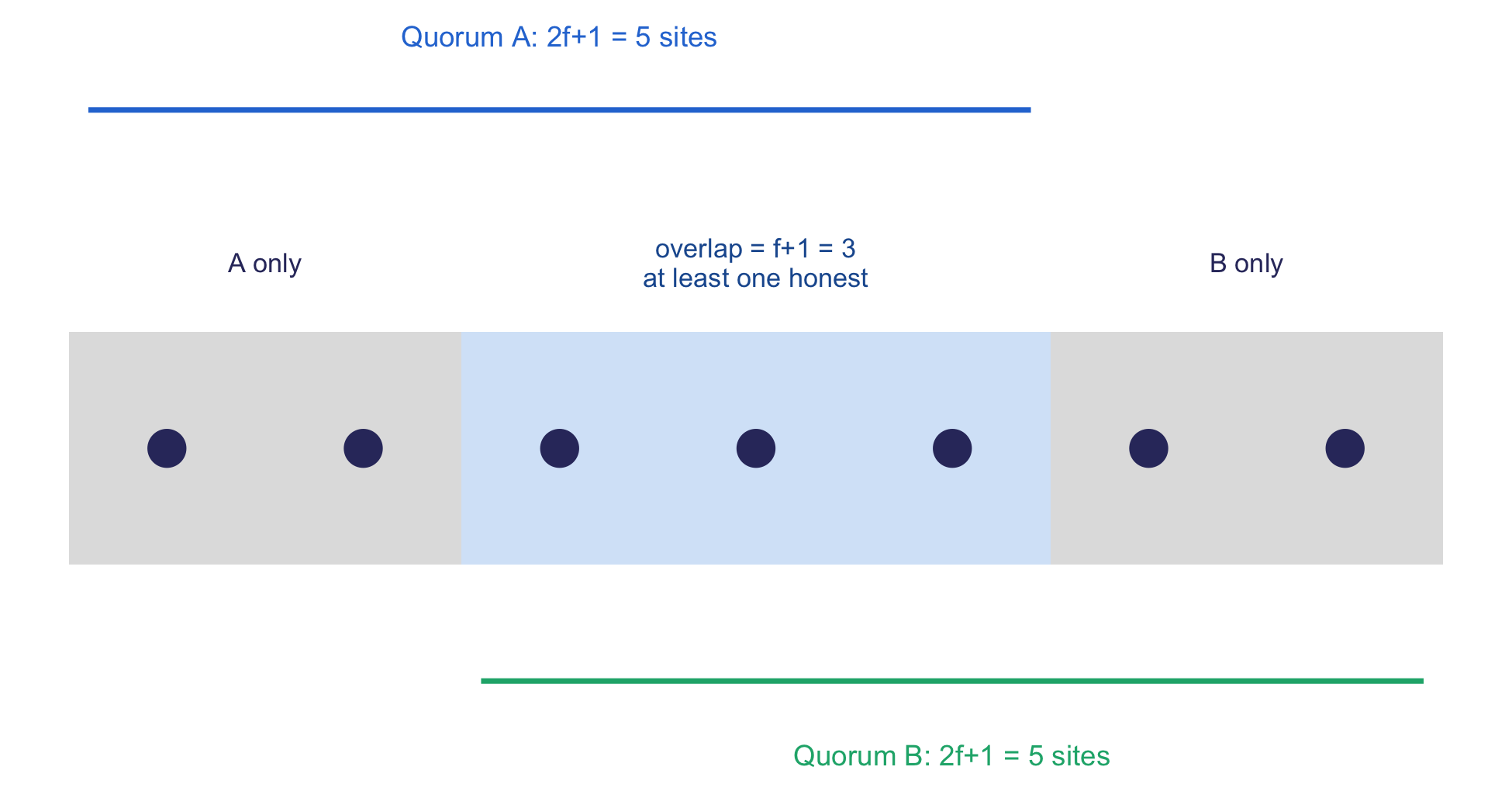
Safety requires overlapping quorums. If two decisions could be made by two disjoint-enough quorums, the Byzantine parties could feed conflicting messages to each quorum and cause two different loyal decisions. To rule this out, any two quorums must share at least one loyal member. Two quorums of size \(q\) drawn from \(n\) parties overlap in at least \(2q - n\) members; even if every Byzantine party is placed in the overlap, a loyal member survives in the overlap only if
\[
2q - n \; \geq \; f + 1.
\]
Liveness requires an achievable quorum. A quorum must be reachable using loyal parties alone, since Byzantine parties cannot be compelled to participate honestly. With \(f\) possible defectors, this requires
\[
q \; \leq \; n - f.
\]
Combining the two, the smallest workable \(q\) satisfies \(q \geq \lceil (n+f+1)/2 \rceil\), and feasibility requires this value not to exceed \(n - f\). Substituting and simplifying gives the classical bound:
\[
n \; \geq \; 3f + 1.
\]
With fewer than \(3f+1\) parties, no protocol, however clever, can guarantee both safety and liveness against \(f\) Byzantine parties: an adversary controlling \(f\) of a smaller system can always engineer either two inconsistent decisions or a stall. The worked example below checks this bound numerically by testing quorum feasibility directly, rather than asking the reader to take the algebra on trust.
Figure 2.2 shows why the overlap argument forces the bound. With n = 3f+1 sites, two quorums of size 2f+1 must share f+1 members, and since at most f of those shared members can be Byzantine, at least one is guaranteed to be honest.
f<-2n<-3*f+1nd<-tibble::tibble(x =1:n, y =0)bands<-tibble::tibble( xmin =c(0.5, 2.5, 5.5), xmax =c(2.5, 5.5, 7.5), fillc =c('grey88', '#d6e6f8', 'grey88'))ggplot()+geom_rect(data =bands,aes(xmin =xmin, xmax =xmax, ymin =-0.55, ymax =0.55), fill =bands$fillc, colour =NA)+geom_point(data =nd, aes(x, y), size =5, colour =struct)+annotate('text', x =1.5, y =0.88, label ='A only', size =2.9, colour =struct)+annotate('text', x =4, y =0.88, label ='overlap = f+1 = 3\nat least one honest', size =2.9, colour ='#1d5a9e', lineheight =0.9)+annotate('text', x =6.5, y =0.88, label ='B only', size =2.9, colour =struct)+annotate('segment', x =0.6, xend =5.4, y =1.6, yend =1.6, colour =PAL[1], linewidth =0.8)+annotate('text', x =3, y =1.95, label ='Quorum A: 2f+1 = 5 sites', colour =PAL[1], size =3.1)+annotate('segment', x =2.6, xend =7.4, y =-1.1, yend =-1.1, colour =PAL[2], linewidth =0.8)+annotate('text', x =5, y =-1.45, label ='Quorum B: 2f+1 = 5 sites', colour =PAL[2], size =3.1)+coord_cartesian(clip ='off')+theme_void()
Figure 2.2: Two quorums of size 2f+1 drawn from 3f+1 sites must share at least f+1 members, so their overlap always contains at least one honest site.
NoteCheck your understanding: why 3f, not 2f
A student argues that tolerating \(f\) liars among \(n\) parties should only require a strict majority, i.e. \(n \geq 2f+1\), since a majority already outvotes the liars. Where does the argument fail?
A strict majority is enough to outvote liars in a single vote, but Byzantine agreement requires that any two quorums used across the protocol’s messages still intersect in a loyal party, and it requires that a quorum be achievable without any cooperation from the (unknown) faulty parties. A bare majority quorum can be entirely disjoint from another bare majority quorum once one removes the possibly-faulty parties from each, breaking the safety property. The extra factor of \(f\) is the price of never needing to trust which parties are faulty.
2.6 State-machine replication as the abstraction
Byzantine agreement generalizes to a useful engineering abstraction called state-machine replication (SMR): a service is defined by a deterministic state machine (a transition function applied to an ordered log of inputs), and the log is replicated across \(n\) parties using a BFT agreement protocol so that every loyal replica applies the same inputs in the same order and therefore reaches the same state. A ledger is exactly this: the ‘inputs’ are transactions, the ‘state’ is the set of account balances or unspent outputs, and the ‘transition function’ is ‘apply the transaction if it is valid, else reject it.’ The trial ledger is an instance of the same abstraction, in which the inputs are enrolment, randomisation and outcome events, the state is the current enrolment and endpoint tally, and the transition function admits an event if it is well formed and consistent with the log so far. Every consensus protocol in this book, from PBFT (a classical agreement protocol for a fixed membership, defined just below) to Nakamoto’s chain to the proof-of-stake protocols of Chapter 10, is best understood as an implementation of SMR under a particular fault model and a particular membership assumption.
Castro and Liskov (Castro & Liskov, 1999), working at the Massachusetts Institute of Technology in 1999, gave the first BFT SMR protocol efficient enough for real deployment: Practical Byzantine Fault Tolerance (PBFT). PBFT runs among a fixed, known set of \(n\) replicas, tolerates up to \(f = \lfloor (n-1)/3 \rfloor\) Byzantine replicas exactly at the \(3f+1\) bound, and reaches deterministic agreement in a small, bounded number of message rounds per decision. It is the template for every permissioned (consortium) blockchain in production today.
The difficulty lies in the phrase ‘fixed, known set.’ PBFT and its relatives require that the identities of the \(n\) participants be established in advance, typically by a credentialing authority admitting named institutions. This is a perfectly reasonable requirement in many real settings, and a fatal one in others, which is exactly the distinction the next section makes precise.
2.7 Sybil attacks and the limits of majority vote
Suppose we relax PBFT’s fixed-membership assumption, as the open disease registry of the Orientation does, and allow anyone to claim a seat in the consensus protocol by, say, announcing a network address or registering as a reporter. Nothing then prevents a single adversary from announcing a thousand addresses. Douceur (Douceur, 2002), in a 2002 study of peer-to-peer systems, named this the Sybil attack and established a stronger result: absent some mechanism that makes acquiring an identity costly, no distributed protocol can bound the number of identities a single adversary controls, and therefore no identity-counting rule (one address, one vote) can be made robust against a resource-poor adversary who merely mints more identities.
This is not a narrow technical gap in PBFT; it is a structural fact about open membership. The \(3f+1\) bound assumes \(f\) is a bounded fraction of a bounded set of identities. Once identity creation is free, \(f\) is unbounded relative to \(n\) measured in identities, and the bound is vacuous. A voting rule that counts identities is the wrong object to defend, no matter how the counting is implemented.
To illustrate, consider the open registry populated by one hundred honest reporters, each of whom files a truthful case report, and a single adversary who mints one hundred and fifty free identities and files a fraudulent report under each. The first code chunk below makes the consequence concrete. Under a rule of one identity, one vote, the fraudulent outcome commands a majority while representing exactly one real, resource-constrained actor.
set.seed(20260702)n_honest<-100n_sybil<-150# SYNTHETIC: identity-counted votes under free identity# creation. Each 'A' is one honest participant; each 'B'# is one Sybil identity minted by a single adversary.votes<-c(rep('A', n_honest), rep('B', n_sybil))table(votes)#> votes#> A B #> 100 150prop_fraudulent<-mean(votes=='B')prop_fraudulent#> [1] 0.6
A single actor with no special resources outvotes the hundred honest reporters, because the ballot counted identities and identities were free. The remedy is not a better counting rule; it is to refuse to count identities at all, and to weight influence instead by something the adversary cannot mint for free. The second chunk repeats the experiment, granting each honest reporter one unit of a scarce resource and granting the adversary a fixed total budget of that resource, which it may split across as many Sybil identities as it likes.
set.seed(20260702)r_honest<-rep(1, n_honest)# SYNTHETIC: the adversary's total resource budget is# fixed regardless of how many identities it mints.# Splitting it more finely does not create more of it.total_attacker_resource<-30r_sybil<-rep(total_attacker_resource/n_sybil, n_sybil)weights<-c(r_honest, r_sybil)side<-c(rep('A', n_honest), rep('B', n_sybil))tapply(weights, side, sum)#> A B #> 100 30
The fraudulent side’s total weight is fixed at 30 no matter how many identities it is divided among; minting more Sybils only divides the same fixed budget more finely. This is the general principle: influence proportional to a scarce, externally verifiable resource is Sybil-resistant by construction, while influence proportional to identity-count is not. Which resource to use, and how to verify a claim on it without a trusted registrar, is exactly the question Chapter 4 answers for computation and Chapter 10 answers for stake.
ImportantThe sceptic’s reflex
‘Blockchain solves the Byzantine Generals problem’ is a narrative-tier claim as usually stated. Classical BFT, solved by Castro & Liskov (1999), already solves Byzantine Generals under a fixed-membership fault model. What Nakamoto consensus adds is a solution to a harder, different problem: Byzantine-style agreement under open membership, where the number and identity of participants is unknown and unbounded. Naming which problem is being solved, fixed membership or open membership, converts this from a marketing line into a protocol fact.
2.8 Nakamoto’s move: probabilistic agreement by scarce resource
Nakamoto’s (Nakamoto, 2008) contribution, in the vocabulary now established, is to replace identity-counted voting with resource-weighted influence, using computational work as the scarce, externally verifiable resource, and to accept a probabilistic form of agreement in place of PBFT’s deterministic one. Chapter Chapter 4 develops the full mechanism; here we note only the shape of the trade.
Instead of \(n\) known parties each casting one vote, anyone may participate, and a participant’s influence over which history is canonical is proportional to the computational work it has expended, verified cheaply by everyone via a cryptographic puzzle. An adversary who controls a minority of the total computational capacity can, with probability that decays exponentially in the number of confirmations, temporarily produce a longer competing history, but cannot do so as a matter of certainty, nor indefinitely. Safety is no longer a theorem holding with probability one under a stated fault bound; it is a tail probability that the reader, possessing a Poisson-process and random-walk toolkit already, is equipped to compute directly. Chapter 4 does exactly that computation.
This is not the first use of costly computation to deter an adversary. Dwork and Naor (Dwork & Naor, 1993) proposed spending computation as a toll to deter denial-of-service attacks and junk email, and Back (Back, 2002) operationalised the idea as a practical proof-of-work stamp. Nakamoto’s innovation was to repurpose that toll, not as an anti-spam fee but as the scarce resource that determines whose vote on transaction order counts, thereby converting a spam deterrent into a Sybil-resistant consensus weight, and coupling it to a longest-valid-chain rule that gives the system a mechanical way to resolve competing histories without a vote in the classical sense at all.
NoteCheck your understanding: what changed and what did not
Compare PBFT and Nakamoto consensus along three axes: membership, the nature of the safety guarantee, and the basis of a participant’s influence. What is genuinely new and what is a repackaging of an older idea?
Membership: fixed and known (PBFT) versus open and unbounded (Nakamoto). Safety guarantee: deterministic once \(f\) respects \(3f+1\) (PBFT) versus probabilistic, improving with confirmations (Nakamoto). Basis of influence: identity (PBFT’s one-replica-one-vote among admitted members) versus a scarce, externally verifiable resource (Nakamoto’s proof-of-work). The genuinely new piece is Sybil-resistant weighting under open membership; the toll-for-computation idea it is built from predates Nakamoto by over a decade (Back, 2002; Dwork & Naor, 1993).
2.9 Permissioned versus permissionless: an engineering choice
None of the foregoing ranks one design above the other. Permissioned BFT (PBFT and its modern descendants) gives deterministic finality, high throughput, and low latency, at the cost of requiring a credentialing process that establishes who the \(n\) parties are. Permissionless Nakamoto-style consensus gives Sybil-resistant, open membership with no credentialing authority at all, at the cost of probabilistic finality, materially higher latency before a transaction is safe to treat as settled, and (in the proof-of-work instance) a real resource expenditure that purchases the Sybil resistance.
The correct choice is a function of the trust environment, not a matter of preference for ‘decentralization’ as a general good. When the set of participants is small, known, accountable to a regulator or contract, and stable over time, permissioned BFT typically dominates on every operational axis. When participation must be open to parties unknown in advance, unaccountable to any shared authority, and free to enter or leave, only a Sybil-resistant, permissionless design is structurally viable, and its extra cost is the price of that openness.
Table 2.2 sets the two consensus designs beside the humbler option we keep returning to, a single signed and audited database, along the axes that decide between them.
Table 2.2: Three designs for a shared record and the trust environment each one fits
Property
Permissioned BFT
Permissionless Nakamoto
Signed audited database
Membership
Fixed, credentialed
Open, unbounded
Single operator
Sybil resistance
Not needed, set is known
By scarce resource
Not applicable
Finality
Deterministic, sub-second
Probabilistic, grows with confirmations
Immediate, one writer
Throughput
High
Low to moderate
Highest
Right tool when
Parties known, few, mutually distrusting
Membership open and unaccountable
One trusted operator suffices
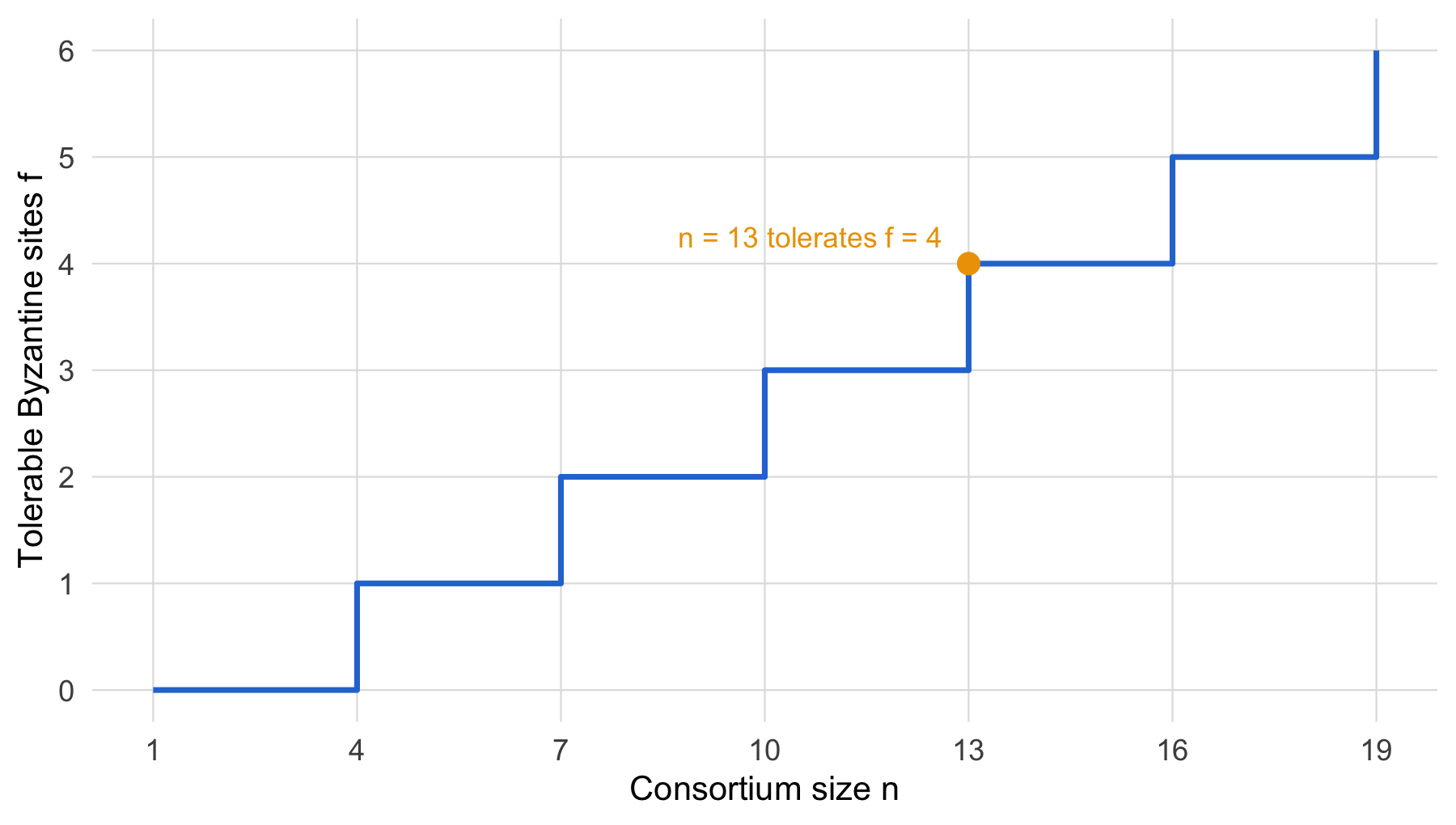
To illustrate the fixed-membership case with the trial ledger in view, consider how the tolerable number of faulty sites grows with the size of the consortium. Under the classical bound a consortium of \(n\) named institutions can tolerate at most \(f = \lfloor (n-1)/3 \rfloor\) simultaneously Byzantine members, those whose servers are compromised, misconfigured, or otherwise misreporting, while still guaranteeing agreement on the trial record.
# SYNTHETIC: Byzantine fault tolerance of a fixed# consortium ledger as a function of the number of# named institutions, via f = floor((n - 1) / 3).consortium<-tibble::tibble(n_sites =c(4, 7, 10, 13, 16))consortium|>dplyr::mutate( max_faulty =(n_sites-1L)%/%3L, honest_needed =n_sites-max_faulty)#> # A tibble: 5 × 3#> n_sites max_faulty honest_needed#> <dbl> <dbl> <dbl>#> 1 4 1 3#> 2 7 2 5#> 3 10 3 7#> 4 13 4 9#> 5 16 5 11
A consortium of thirteen parties, the twelve hospitals and one regulator of the callout below, may thus tolerate up to four compromised or misreporting members while still reconstructing one agreed history, and it requires nine honest members to do so. Should the consortium later wish to tolerate more faults, the bound becomes a design constraint on how many institutions must be enrolled, a point we take up again in the exercises.
Plotting the same bound over a range of consortium sizes, Figure 2.3 shows that tolerance rises as a step function: three further institutions buy exactly one more tolerable fault, with the thirteen-party consortium of the callout below sitting on the f = 4 tread.
Figure 2.3: Tolerance rises as a step function of consortium size, gaining one more tolerable Byzantine site only when three further institutions join.
WarningMulti-hospital trial data: which tool, honestly
This is the trial ledger of the Orientation, now regarded as an engineering choice. We have a phase III trial run across a consortium of, say, twelve hospitals and a regulator, none of whom fully trusts the others to control the shared enrolment and endpoint log unilaterally, but all of whom are named, contracted, and accountable institutions. This is a textbook fixed-membership setting: \(n = 13\) is known, \(f\) may be bounded by contract (how many parties the consortium is willing to assume might misreport or go offline), and a PBFT-style consortium ledger delivers tamper-evident, jointly-audited agreement on the trial record with sub-second finality and no proof-of-work energy cost. Reaching instead for a permissionless chain, with its unbounded, anonymous validator set and probabilistic finality, buys Sybil resistance the problem never needed, at real cost in latency, throughput, and operational complexity. The right engineering answer here is a permissioned ledger, or, in a great many such consortia, a conventional database with cryptographic audit logging and no consensus protocol running at all, per the warning in Chapter 1. We reserve the permissionless machinery for the case that genuinely has open, unaccountable membership, such as a public disease registry meant to be independently verifiable by parties who will never be enumerated in advance.
2.10 Permissioned ledgers and the health deployments
We have argued that the trial ledger, a fixed and named consortium of accountable hospitals, is the permissioned case, and we now take that case seriously. We do so for two reasons: it is the honest setting for our running example, and it is where very nearly every deployed health-sector ledger actually lives. The open-membership machinery that occupies the remainder of this book is, for the health scientist, the exception and not the rule.
What does a ledger look like when the membership is known in advance? The most widely deployed permissioned design, Hyperledger Fabric, an open-source permissioned-ledger framework hosted by the Linux Foundation, is instructive precisely because it departs from the Bitcoin template. The public chains of the preceding sections follow an order-execute discipline: the consensus protocol orders the transactions first, and every node then executes all of them in that fixed order. Fabric, as Androulaki and colleagues describe it (Androulaki et al., 2018), rearranges this into an execute-order-validate pipeline. A transaction is first executed, or endorsed, by a nominated subset of peers, who simulate it against their copy of the state and sign the result; the signed endorsements are then ordered by a separate ordering service; and each peer finally validates the ordered transactions against an endorsement policy before committing them. The rearrangement is not cosmetic. It lets mutually distrusting organisations agree on state without requiring every node to run every computation in lockstep, and it isolates the ordering service as the one component that must be agreed upon.
The deeper point, for our purposes, is what a known membership buys. When the writers are a fixed roster of named institutions, the Sybil attack of the previous section simply cannot arise, since no party can mint new identities that the others will honour. The problem reduces to classical Byzantine agreement among a known set, which Castro and Liskov’s practical protocol (Castro & Liskov, 1999) solves at the 3f+1 threshold we derived, and proof-of-work, with its deliberate and enormous energy cost, becomes unnecessary. We should be precise, however, about how much fault tolerance a deployed system actually buys, since the table below names classical Byzantine agreement as the permissioned answer and practice is often weaker. Fabric, for one, has in its common configurations ordered transactions with a crash-fault-tolerant protocol such as Raft, which tolerates orderers that halt but assumes they do not lie; full Byzantine ordering is available but is not the default. The distinction is itself a trust decision: Byzantine tolerance guards against a corrupted insider at the ordering layer, crash tolerance only against one that fails honestly, and a consortium must decide which threat it is buying against. With that caveat noted, a permissioned ledger recovers high throughput, low latency, and negligible energy, at the price of the very thing that makes public chains interesting: it presupposes that the membership can be agreed upon in the first place.
Table 2.3: The two architectures contrasted. The rearrangement of steps is what lets a permissioned ledger dispense with proof-of-work.
Where, then, has the health sector actually put these ideas to work? The literature is by now sizeable. Azaria and colleagues’ MedRec (Azaria et al., 2016) proposed a ledger for medical-record access and permission management, and it remains the most cited work in the area. The informatics community’s own assessments (Kuo et al., 2017), the systematic review of Agbo and colleagues (Agbo et al., 2019), proposals for clinical-trial provenance (Benchoufi & Ravaud, 2017), designs for patient-driven interoperability (Gordon & Catalini, 2018), and integrations with the FHIR health-data standard (Zhang et al., 2018) together describe an active decade of work. A public-health reader might reasonably conclude that the matter is settled and that these ledgers are in routine clinical use.
Unfortunately, they are largely not, and it is worth asking why. The systematic reviews are consistent on this point: the great majority of these efforts are pilots and proofs of concept, and few have reached production scale. The explanation is not a failure of engineering but a failure of fit, and Wust and Gervais (Wüst & Gervais, 2018), in a 2018 analysis of when a blockchain is genuinely needed, give the decision criterion that makes the failure legible. A blockchain earns its considerable cost, they argue, only when three conditions hold together: there are multiple writers, no trusted third party is available, and the writers’ interests may conflict. Many health proposals satisfy the first and third conditions but not the second, because a trusted custodian, a hospital’s information-technology department or a trial’s data-coordinating centre, is in fact available and acceptable. When such a custodian exists, a well-governed database with cryptographic audit logging delivers tamper-evidence at a fraction of the cost, and the ledger is machinery in search of a problem.
ImportantThe sceptic’s reflex
‘Blockchain for health records’ is, in the majority of the proposals that carry the phrase, a tier-four narrative presented in the guise of a tier-one protocol fact. The reflex is to apply the Wust and Gervais test before granting the claim: name the writers, ask whether a trusted custodian is genuinely unavailable, and ask whether their interests actually conflict. Most proposals fail at the second question.
This returns us to the trial ledger, and to an honest verdict. Of the health cases in the literature, a fixed consortium of hospitals sharing a trial record is among the strongest, since the distrust among named parties is real and the regulatory demand for an independent audit is genuine. Even here, however, the permissioned ledger does not win by default. It competes against a simpler arrangement in which one operator maintains a signed, append-only log that every site replicates and checks, and the choice between them turns on a single question: can the consortium agree on who operates the log? If it can, the database is the better tool; if it genuinely cannot, the permissioned ledger earns its place. We shall keep this question in view as the machinery grows more elaborate in the chapters ahead.
NoteCheck your understanding: does the trial ledger need a chain?
A pharmaceutical sponsor proposes to run the trial ledger on a public blockchain ‘for maximum transparency and immutability’. Applying the Wust and Gervais criterion, what is the first question to ask, and what cheaper design should be the comparator?
The first question is whether a trusted custodian is genuinely unavailable, because if the sites will accept any single operator, no blockchain of any kind is warranted. A public chain is doubly wrong here: it exposes enrolment and outcome data to the world, which the hashing of Chapter 1 shows is not anonymised by hashing alone, and it pays proof-of-work costs to solve a Sybil problem that a closed consortium does not have. The correct comparator is a signed, replicated, append-only audit log, and only if the sites cannot agree on its operator does a permissioned consortium ledger become the answer.
2.11 Worked example
The quorum-feasibility argument behind \(n \geq 3f+1\) was given algebraically above. This worked example checks it computationally: for a range of fault counts \(f\), is a quorum of the required size simultaneously (a) large enough to guarantee two quorums share a loyal member, and (b) small enough to be reachable using loyal parties alone? The function below implements exactly the two inequalities derived earlier, and nothing else.
quorum_exists<-function(n, f){q_min<-ceiling((n+f+1)/2)q_min<=n-f}f_vals<-1:6# n = 3f: one short of the classical boundpurrr::map2_lgl(3*f_vals, f_vals, quorum_exists)#> [1] FALSE FALSE FALSE FALSE FALSE FALSE# n = 3f + 1: exactly at the classical boundpurrr::map2_lgl(3*f_vals+1, f_vals, quorum_exists)#> [1] TRUE TRUE TRUE TRUE TRUE TRUE
The first line is FALSE at every tested \(f\): with only \(n = 3f\) parties, no quorum size satisfies both the safety and the liveness inequality simultaneously, so no protocol relying on quorum intersection can guarantee both properties. The second line is TRUE at every tested \(f\): adding a single additional party, reaching \(n = 3f+1\), is both necessary and sufficient. The bound derived by hand in the previous section is not an approximation or a rule of thumb; it is exact, and the simulation above is merely evaluating the same two inequalities Lamport, Shostak, and Pease established, at a handful of parameter values, as a check that the algebra was not mis-transcribed.
2.12 Collaborating with an LLM
Prompt: ‘Explain why proof-of-work solves the Byzantine Generals problem.’ Watch for: Most LLM answers to this prompt conflate the classical, fixed-membership Byzantine Generals problem, already solved by PBFT, with the open- membership Sybil-resistance problem that proof-of-work actually addresses. An answer that does not distinguish the two, or that claims proof-of-work gives a deterministic guarantee, is repeating a common but imprecise account. Verification: Ask the model to state explicitly whether its claimed guarantee is deterministic or probabilistic, and under what fault model. Cross-check the stated fault model against Castro & Liskov (1999) for the permissioned case and against the tail-probability argument of Chapter 4 for the permissionless case.
Prompt: ‘Derive the minimum number of nodes needed to tolerate f Byzantine faults.’ Watch for: Models frequently state \(n \geq 3f+1\) correctly as a fact but skip or garble the derivation, particularly the step requiring quorum overlap to contain a loyal member rather than merely a nonempty intersection. Verification: The reader may reproduce the two inequalities, \(2q - n \geq f+1\) and \(q \leq n-f\), independently, and check that the model’s derivation actually combines them rather than asserting the bound. The quorum_exists() function above is a fast independent check at specific values of \(n\) and \(f\).
Prompt: ‘Design a consensus mechanism for a multi-hospital clinical trial consortium.’ Watch for: A default LLM answer often proposes a permissionless, proof-of-work or proof-of-stake design by association with ‘blockchain’ generally, without asking whether membership is in fact fixed and known. Verification: Before accepting any design, establish whether the participant set is fixed, named, and contractually accountable. If so, insist the model justify any permissionless component against a plain PBFT-style consortium ledger, or a conventional audited database, on concrete operational grounds rather than by assertion.
2.13 Exercises
A protocol uses quorums of size \(q = \lceil (n+1)/2
\rceil\) (a bare majority) among \(n\) parties, of which \(f\) may be Byzantine. Derive the largest \(f\), as a function of \(n\), for which this quorum size still satisfies both the overlap inequality and the achievability inequality from this chapter. Compare it to the \(3f+1\) bound and explain the gap.
Extend the quorum_exists() function to also return the minimal feasible \(q\) itself (not just a logical), and use it to tabulate, for \(f = 1, \dots, 10\), the smallest \(n\) at which a feasible quorum first appears. Confirm the pattern matches \(n = 3f+1\) exactly.
Modify the Sybil-vote simulation so that the adversary’s total resource budget, rather than being fixed at 30, is drawn as total_attacker_resource <- n_honest * runif(1, 0, 1) for a single simulated draw. At what fraction of n_honest does the resource-weighted vote flip in the adversary’s favor? Is this threshold sensitive to n_sybil? Explain why or why not, referring to the mechanics of the simulation.
Prove that no protocol using a single, fixed quorum size \(q\) can be both safe and live against \(f \geq n/3\) Byzantine parties, without assuming the specific inequalities of this chapter as given; construct the adversary strategy directly (i.e. exhibit two quorums an adversary can force to disagree).
A consortium of five named hospitals wants Byzantine fault tolerance against the possibility that any single member’s system is compromised or misreports. Using the \(3f+1\) bound, determine the largest \(f\) the consortium can tolerate, and state what changes about the required design if the consortium later wants to tolerate two simultaneous compromised members instead.
Write one paragraph arguing, in the tier-language of Chapter 1, whether ‘a permissionless blockchain is more secure than a permissioned consortium ledger’ is a protocol fact, an empirical claim, an economic claim, or a narrative, as usually stated. Identify the missing qualifiers that would be needed to promote it to a tier-one or tier-two claim.
2.14 Further reading
Lamport et al. (1982) is the founding paper of this entire chapter and should be read before anything else; the generals allegory is a device, but the impossibility and possibility results are the mathematical content. Read Castro & Liskov (1999) next for the first practical, deployable BFT protocol, and note precisely which assumptions (fixed membership, known \(n\), partial synchrony) make its efficiency possible. Douceur (2002) is short and should be read in full; it is the paper that explains why every naive open-membership voting scheme one might invent independently has already been shown broken. Nakamoto (2008) is the primary source for the resolution this chapter previews and Chapter 4 develops in full; read it before any secondary account. Narayanan et al. (2016) gives the fullest rigorous textbook treatment of the material in this chapter and the next several. Bonneau et al. (2015) is the standard systematization of the broader research literature this chapter draws its first vocabulary from, and is the right next stop once the primary sources are read. Dwork & Naor (1993) and Back (2002) are the pre-Bitcoin lineage of ‘computation as a costly toll’; reading them clarifies exactly what Nakamoto added and what was already known.
In conclusion, three points are to be emphasised. First, the object every protocol in this book pursues is agreement on one ordered history among mutually distrusting parties, and for the trial ledger it is this object, not any particular technology, that a regulator ultimately audits. Second, the classical theory is sharp and known: agreement among \(n\) fixed, identified parties tolerating \(f\) Byzantine faults is possible precisely when \(n \geq 3f+1\), and no cleverness recovers the guarantee below that threshold. Third, the permissionless machinery of the later chapters earns its considerable extra cost only under open, unaccountable membership, as in a public disease registry, whereas when the participants are in fact a fixed, named consortium, as the trial hospitals are, a permissioned ledger, or even a well-governed audited database, is the more responsible choice.
Agbo, C. C., Mahmoud, Q. H., & Eklund, J. M. (2019). Blockchain technology in healthcare: A systematic review. Healthcare, 7(2), 56. https://doi.org/10.3390/healthcare7020056
Androulaki, E., Barger, A., Bortnikov, V., Cachin, C., et al. (2018). HyperledgerFabric: A distributed operating system for permissioned blockchains. Thirteenth EuroSys Conference (EuroSys). https://doi.org/10.1145/3190508.3190538
Azaria, A., Ekblaw, A., Vieira, T., & Lippman, A. (2016). MedRec: Using blockchain for medical data access and permission management. 2nd International Conference on Open and Big Data (OBD), 25–30. https://doi.org/10.1109/OBD.2016.11
Bonneau, J., Miller, A., Clark, J., Narayanan, A., Kroll, J. A., & Felten, E. W. (2015). SoK: Research perspectives and challenges for Bitcoin and cryptocurrencies. IEEE Symposium on Security and Privacy (s&p), 104–121. https://doi.org/10.1109/SP.2015.14
Dwork, C., & Naor, M. (1993). Pricing via processing or combatting junk mail. Advances in Cryptology — CRYPTO ’92, LNCS, 740, 139–147. https://doi.org/10.1007/3-540-48071-4_10
Gordon, W. J., & Catalini, C. (2018). Blockchain technology for healthcare: Facilitating the transition to patient-driven interoperability. Computational and Structural Biotechnology Journal, 16, 224–230. https://doi.org/10.1016/j.csbj.2018.06.003
Kuo, T.-T., Kim, H.-E., & Ohno-Machado, L. (2017). Blockchain distributed ledger technologies for biomedical and health care applications. Journal of the American Medical Informatics Association, 24(6), 1211–1220. https://doi.org/10.1093/jamia/ocx068
Lamport, L., Shostak, R., & Pease, M. (1982). The Byzantine generals problem. ACM Transactions on Programming Languages and Systems, 4(3), 382–401. https://doi.org/10.1145/357172.357176
Nakamoto, S. (2008). Bitcoin: A peer-to-peer electronic cash system. Self-published whitepaper. https://bitcoin.org/bitcoin.pdf
Narayanan, A., Bonneau, J., Felten, E. W., Miller, A., & Goldfeder, S. (2016). Bitcoin and cryptocurrency technologies: A comprehensive introduction. Princeton University Press. https://bitcoinbook.cs.princeton.edu/
Wüst, K., & Gervais, A. (2018). Do you need a blockchain? Crypto Valley Conference on Blockchain Technology (CVCBT), 45–54. https://doi.org/10.1109/CVCBT.2018.00011
Zhang, P., White, J., Schmidt, D. C., Lenz, G., & Rosenbloom, S. T. (2018). FHIRChain: Applying blockchain to securely and scalably share clinical data. Computational and Structural Biotechnology Journal, 16, 267–278. https://doi.org/10.1016/j.csbj.2018.07.004