We present ‘Ouroboros’, the first blockchain protocol based on proof of stake with rigorous security guarantees.
Kiayias, Russell, David, and Oliynykov, Ouroboros: A Provably Secure Proof-of-Stake Blockchain Protocol (2017)
10.1 Learning objectives
By the end of this chapter the reader should be able to:
Explain how proof-of-stake replaces the burned energy of proof-of-work with slashable capital as the source of Sybil resistance, and describe the roles of validators, attestations, and proposals.
State the accountable-safety guarantee of Casper FFG and its realisation in Gasper, and relate it to the provably-secure Ouroboros family.
Name the behaviours that slashing punishes (equivocation and surround voting) and explain why the penalty must destroy stake rather than merely forfeit reward.
Read a cost-of-attack calculation as a statement about capital at risk, and contrast the recurring rental cost of a proof-of-work attack with the self-inflicted capital loss of a proof-of-stake attack.
Recognise leader and committee selection as weighted sampling, and bound the representativeness of a sampled committee with a concentration argument.
Model restaking as a correlated-loss problem with a Gaussian copula, and quantify how correlation, at fixed marginal risk, inflates the probability of a large joint loss.
10.2 Orientation
We return once more to the trial ledger. Several hospitals maintain a shared, append-only record of enrolment, randomisation, and outcome events, with no single institution trusted to hold the master copy, and a regulator who audits the record only after the fact. In Chapter 4 we learned to secure such a ledger by proof-of-work: to append a block a participant must burn energy, and to rewrite finalised history an attacker must out-burn the honest network (Chapter 6). The mechanism is sound, but it is extravagant, and for a consortium of hospitals the prospect of defending a patient-safety record by incinerating electricity has little intuitive appeal. The matter may be put as a question. What secures a shared ledger once the burning of energy is set aside?
Proof-of-stake offers an answer by changing the collateral. Weight in the protocol is no longer proportional to the energy a participant burns but to the capital the participant locks in a bond, and misbehaviour is punished not by wasted electricity but by destroying part of that bond. The scarce resource is no longer electricity but capital that the protocol can confiscate. This single substitution reorganises the entire security argument, and we shall find it best read not as a change of technology but as a change of collateral.
Before proceeding we fix the vocabulary on which the rest of the chapter depends, so that the reader need not carry these terms as mysteries.
NoteThe vocabulary of this chapter
Several terms recur throughout the chapter. We define them here and use them consistently thereafter.
Proof-of-stake. A consensus protocol in which a participant’s influence is proportional to the capital it locks in a bond, rather than to the computation it performs, and in which misbehaviour is punished by destroying part of that bonded capital.
Validator. A participant that locks a quantity of the chain’s native asset in a bond and in return takes part in proposing and voting on blocks. Its influence is the share of the total staked capital that its bond represents.
Stake and slashing. The stake is the bonded capital a validator places at risk. Slashing is the protocol’s destruction of part of that bond as the penalty for a provable violation, so that misbehaviour costs a validator its own capital rather than a forgone reward.
Accountable (economic) finality. A guarantee that once a block is finalised, reverting it forces a large and identifiable set of validators to have provably broken a rule, so that reversal carries a price denominated in slashed stake. It is contrasted with the merely probabilistic finality of proof-of-work, under which a reversal grows unlikely with depth but is never ruled out.
Finality gadget. A protocol component layered on a chain that periodically marks certain blocks as finalised, thereby converting the probabilistic guarantee into the accountable one.
Sortition. The random selection of validators for a consensus duty, drawn in proportion to stake. It is a weighted lottery, and in statistical terms it is sampling with probability proportional to size.
Committee. The random subset of validators that sortition selects to attest to a given block. The committee stands in for the whole validator set so that not every validator need vote on every block.
Restaking and rehypothecation.Restaking reuses capital already bonded to secure the base chain to secure additional services at the same time. Rehypothecation is the general term for pledging one asset as collateral against several obligations at once; restaking is its application to staked capital.
The reader already owns the tools to analyse it. The claim that ‘proof-of-stake is secure’ is a cost-of-attack inequality, and cost of attack is capital at risk, a quantity a statistician prices routinely. The claim that a small committee may stand in for the whole validator set is a statement about a weighted sample and its concentration around a population quantity, which is to say a statement of exactly the kind the reader met in survey-sampling coursework. The claim that restaking earns extra yield ‘for free’ is a claim about a joint tail probability, and whether it holds depends entirely on a correlation the marketing does not mention. Each of these is a translation into a language the reader speaks fluently, and once translated, each becomes checkable.
Two protocol facts anchor what follows. First, finality in the Casper sense (Casper being Ethereum’s finality gadget, treated in detail below) is accountable: should the chain ever finalise two conflicting histories, a large and identifiable fraction of the staked capital has provably broken a rule and can be slashed. Reverting finalised history therefore carries a price floor denominated in stake, and we shall let that price arrive, as a number, through the cost-of-attack comparison below. Second, restaking rehypothecates one bond to secure many services at once, which is leverage, and leverage together with a shared shock is a correlated-liquidation problem. The statistician’s edge, here as in survival analysis, is to price the tail that the leverage narrative ignores.
10.3 The statistician’s contribution
Three judgements in this chapter are automated by no client software and by no audit tool. They are the work, and each is a translation of a protocol slogan into a statistical object the reader can interrogate.
1. Cost of attack is capital at risk, and the structure of the risk matters more than the headline number. A proof-of-work attacker rents hash power for an attack window and recovers most of the outlay afterwards, so the cost is an operating expense. A proof-of-stake attacker must post a bond that slashing can destroy, so the cost is the attacker’s own capital placed inside the blast radius. The two figures may be comparable in dollars while being categorically different in kind, and naming that difference, rather than quoting a dollar figure, is the analyst’s contribution.
2. Sortition is sampling, so its guarantees are concentration inequalities, not promises. A committee drawn in proportion to stake is a weighted sample of the validator set, selected with probability proportional to size in exactly the sense the reader met in the design of complex health surveys. That the committee ‘represents’ the whole set is precisely the statement that a sample mean concentrates around a population mean, and the rate of concentration is a Hoeffding or Chernoff bound the reader can write down. The concentration argument that makes a committee trustworthy is the same argument that makes a well-designed survey sample trustworthy, and to treat the guarantee as anything softer than a tail bound is a category error.
3. Restaking is correlated risk, and correlation is the whole story. At a fixed marginal slashing probability, whether restaking is prudent or reckless depends on the correlation between slashing events across services. Independent risks aggregate near their mean; correlated risks develop a fat joint tail. This is the shared-frailty object of survival analysis and the correlated-censoring object of the multi-site trial, and it is, at bottom, the reinsurer’s problem: rehypothecating one pool of capital across many liabilities is structurally the problem of writing many correlated policies against one reserve. A statistician who has priced those tails is well placed to price this one, which the yield-focused literature systematically underprices.
10.4 From burned energy to slashable capital
In proof-of-work, an identity’s influence is its share \(q\) of the global hash rate, and the cost of acquiring influence is the cost of the corresponding hardware and electricity. The defence against the Sybil attack, in which one adversary fabricates many identities, was broached by Douceur (2002), who named and formalised the attack: fabricating identities does not multiply influence, because a thousand node identities backed by one machine still command only that machine’s hash share. Influence is anchored to a physical, external, burned resource.
Proof-of-stake anchors influence to an internal resource instead. A participant becomes a validator by locking a quantity of the chain’s own native asset in a bond, and influence is that bond’s share of the total staked capital. Sybil resistance is then immediate and by construction: splitting one bond across a thousand validator identities does not change its total stake share, so identities are free but weight is not. The defining move, we note, is that the scarce resource, capital, is now denominated in the system’s own unit of account and is confiscable by the protocol. That confiscability is what makes the security argument work, and it is what proof-of-work cannot offer, since no protocol can reach into the physical world and burn an attacker’s electricity after the fact.
10.4.1 Validators, attestations, and proposals
The consensus duties of a validator set reduce to two primitives.
A proposal is the block a designated validator (the proposer or leader for a slot) puts forward to extend the chain. Time is divided into slots, and each slot has one proposer selected by the protocol’s sortition rule.
An attestation is a signed vote by a validator in favour of a particular block as the head of the chain and in favour of a particular checkpoint as a finalisation target. Attestations are the raw material of both the fork-choice rule (the rule that selects the chain’s head among competing branches) and the finality gadget.
Weight everywhere is stake, not head count. A block’s support, a checkpoint’s support, and the threshold for finality are all measured as a fraction of total staked capital. A validator with twice the bond casts an attestation worth twice as much. This is the single fact that lets us carry the reader’s intuition about weighted samples and capital-weighted losses directly into the protocol: everywhere the protocol says ‘two thirds of validators’, read ‘two thirds of stake’.
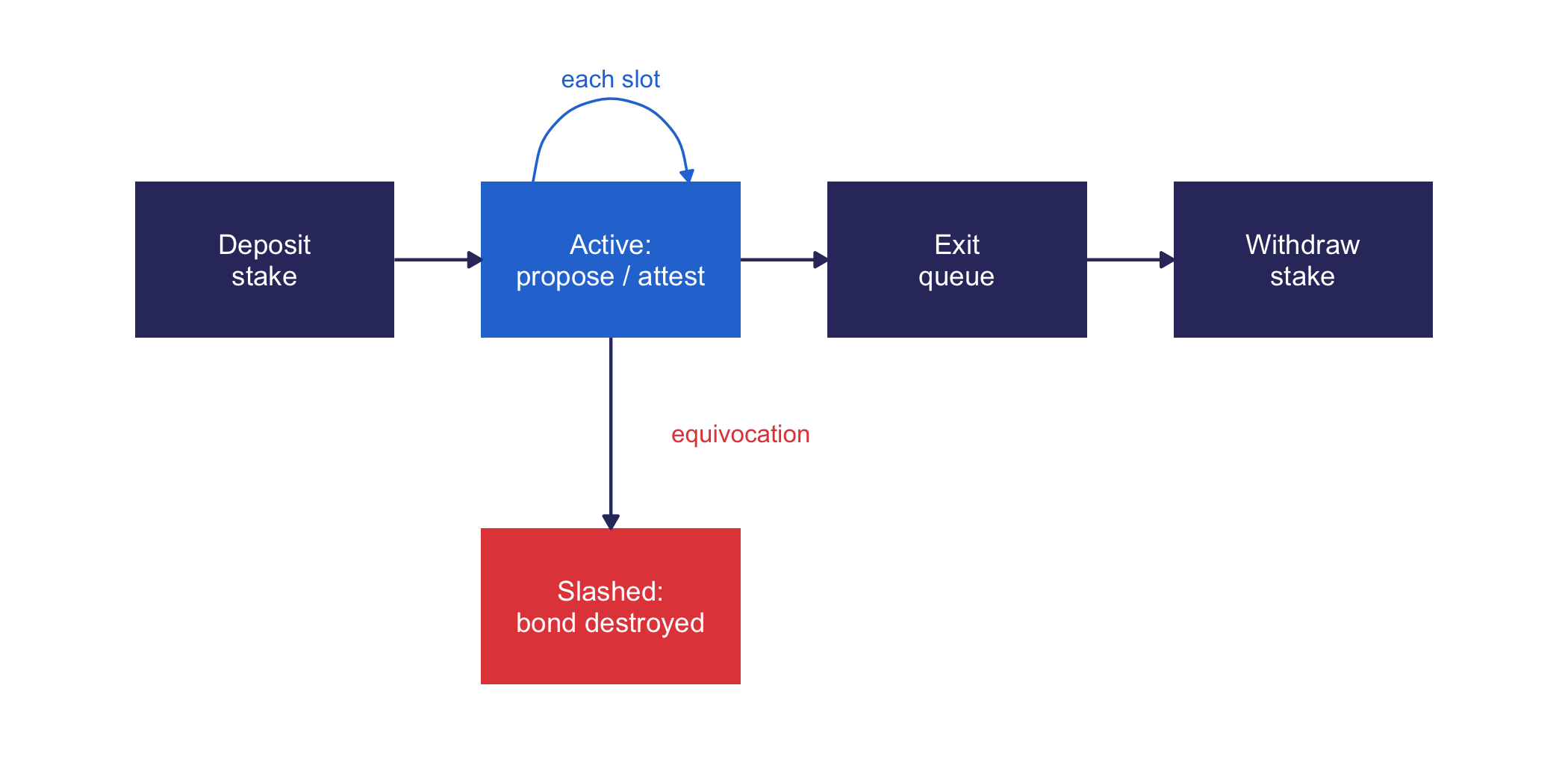
The duties resolve into a lifecycle for the bond itself. Figure 10.1 traces that bond from deposit, through the repeated per-slot duty of proposing and attesting, to one of two exits: a voluntary withdrawal, or the involuntary destruction of the bond by slashing should the validator equivocate.
Figure 10.1: A validator bond moves from deposit, through the repeated per-slot duty of proposing and attesting, to one of two exits: a voluntary withdrawal, or the involuntary destruction of the bond by slashing when the validator equivocates.
NoteCheck your understanding: identities are free but weight is not
In proof-of-work, why does running a thousand node identities on one machine not increase an attacker’s consensus weight, and what is the exact analogue in proof-of-stake?
In proof-of-work, consensus weight is the fraction of global hash rate a participant controls. A thousand identities backed by one machine share that machine’s single hash rate, so the total weight is unchanged; identities are costless but weight is bought only with hashing. In proof-of-stake the analogue is exact with ‘stake’ substituted for ‘hash rate’: a thousand validator identities splitting one bond share that bond’s stake, so total weight equals the total stake regardless of how many identities it is spread across. In both systems the Sybil defence is that weight is tied to an external scarce resource that fabricating identities does not multiply.
10.5 Finality gadgets: Casper, Gasper, and Ouroboros
Nakamoto consensus offers only probabilistic finality: a block \(z\) deep can still be reverted, but the probability of a successful reorganisation decays geometrically in \(z\) (Chapter 6). A finality gadget replaces this asymptotic guarantee with a sharp economic one. After a block is finalised, reverting it is not merely unlikely; it is provably expensive, with a price denominated in slashable stake.
10.5.1 Casper FFG and accountable safety
Casper the Friendly Finality Gadget, proposed by Buterin and Griffith (Buterin & Griffith, 2017), operates on checkpoints, periodic blocks (one per epoch, an epoch being a fixed span of consecutive slots) that validators vote to justify and then finalise. A validator’s vote is a link from a source checkpoint \(s\) to a target checkpoint \(t\), written \(s \to t\). A checkpoint is justified when links from more than two thirds of total stake point to it from a justified source, and a justified checkpoint is finalised when its direct child is justified in the immediately following epoch.
The two-thirds threshold is not arbitrary. It is the smallest supermajority for which two conflicting finalisations force a large, identifiable set of validators to have broken a rule. Casper imposes two slashing conditions on every validator:
No double vote (no equivocation). A validator must not publish two distinct attestations for the same target epoch. Formally, no two links \(s_1 \to t\) and \(s_2 \to t\) with \(s_1 \ne s_2\).
No surround vote. A validator must not publish a link \(s_1 \to t_1\) that strictly surrounds another of its links \(s_2 \to t_2\), meaning \(s_1 < s_2\) and \(t_2 < t_1\).
From these two conditions follows the central result.
TipAccountable safety (informal)
If two conflicting checkpoints are both finalised, then validators controlling at least one third of the total stake have provably violated a slashing condition, and the violation is a publicly verifiable piece of evidence (two of their own signed, contradictory attestations).
The proof is a counting argument the reader can reconstruct. Each of the two conflicting finalisations required a two-thirds supermajority. Two sets each holding more than \(2/3\) of the stake must overlap in more than \(1/3\) of the stake, and the overlapping validators, having voted for both histories, must have either double-voted or surround-voted. Their contradictory signatures are the evidence. This is economic or accountable finality: safety is not unconditional, but any violation of it burns at least a third of all staked capital and leaves a signed confession. Reverting finalised history therefore has a hard price floor, and that floor is the \(0.34\) coefficient that will reappear in the cost-of-attack calculation below.
10.5.2 Gasper: fork choice plus finality
A finality gadget must be married to a fork-choice rule that decides the chain head between finalisations. Gasper, set out by Buterin and colleagues (Buterin et al., 2020), is that marriage: it combines a stake-weighted variant of the GHOST fork-choice rule (LMD-GHOST, which weights subtrees by validators’ latest messages) with Casper FFG finality. GHOST descends from the proposal of Sompolinsky and Zohar (Sompolinsky & Zohar, 2015); Gasper’s contribution is to prove that the composite protocol is safe and live in a partially synchronous network under an honest-majority-of-stake assumption. It is the consensus core of Ethereum after its transition to proof-of-stake. The division of labour is worth naming: LMD-GHOST chooses a head every slot so the chain makes progress, while Casper FFG periodically stamps checkpoints as finalised so that progress becomes irreversible at a known cost.
10.5.3 Ouroboros: provable security from the ground up
Where Casper and Gasper add finality to an existing chain, Kiayias and colleagues designed the Ouroboros family (Kiayias et al., 2017) from the outset as a proof-of-stake protocol with a formal security reduction. Its leader election is a stake-weighted lottery seeded by a jointly-generated randomness beacon, and its principal theorem shows that the protocol realises a robust transaction ledger (with persistence and liveness) as long as a majority of stake is controlled by honest parties, under a rigorously specified network and adversary model. The significance for a quantitative reader is the style of the guarantee: it is a theorem with stated assumptions, in the tradition of the ‘backbone’ analyses that model a blockchain as a formal protocol and prove its properties, due to Garay, Kiayias and Leonardos (Garay et al., 2015) and Pass, Seeman and Shelat (Pass et al., 2017), not an appeal to observed behaviour. When assessing any proof-of-stake system, the first question is which of these two regimes it lives in, a provable-security reduction with explicit assumptions, or an economic argument whose assumptions must be surfaced and checked.
Warning‘Proof-of-stake is more secure’ needs a qualifier
The comparison is not scalar. Proof-of-stake offers accountable finality, which proof-of-work does not, and it removes a large recurring energy cost. It also introduces failure modes proof-of-work lacks: stake can be highly concentrated (a security-relevant Gini, revisited in Chapter 11), long-range and weak-subjectivity attacks (in which an adversary rewrites history from far in the past, exploiting that staked capital, unlike burned energy, leaves no external trace) require out-of-band checkpoints to defend, and the same capital can be levered across services through restaking. ‘More secure’ is only meaningful once one names the threat model, the assumption, and the cost of violating it. Demote the unqualified claim to the economic tier and ask for its assumptions.
10.6 The cost of attack: capital at risk
The accountable-safety result gives a lower bound on the cost of reverting finalised history: at least one third of total stake is slashed. We can now make the proof-of-work versus proof-of-stake contrast concrete. The following helper is reused verbatim from the verified companion; the numbers are illustrative but the structure is the lesson.
Read the two functions as models, not as quotes. The proof-of-work cost is a flow: rent \(51\%\) of the hash rate for the duration of the attack window, an operating expense the attacker recovers most of once the rented hardware is returned. The proof-of-stake cost is a stock: acquire roughly a third of the staked capital and then lose it to slashing when the equivocation is detected. The coefficient \(0.34\) is not decoration; it is the one-third overlap from the accountable-safety proof. The categorical difference is the point. In proof-of-work the attacker rents a weapon; in proof-of-stake the attacker’s own capital is the weapon, and firing it destroys it. This is the real content of the slogan ‘security is capital at risk’, and it is a statement a statistician should insist on stating precisely rather than accepting as folklore.
Table 10.1 sets the two mechanisms side by side along the dimensions a consortium actually weighs: what is scarce, whether the cost is a flow or a stock, how much of it the attacker recovers, the character of finality, and the monitoring analogue a hospital consortium would deploy in place of a posted bond.
Table 10.1: Proof-of-work and proof-of-stake compared along the dimensions a consortium weighs.
Dimension
Proof-of-work
Proof-of-stake
Scarce resource
External hash power: energy and hardware
Internal bonded capital, in the chain’s own unit
Cost structure
Flow: rent hash power for the attack window
Stock: post a bond the protocol can destroy
Attack cost recovery
Mostly recovered; the rented hardware is returned
Self-inflicted; the bond is slashed and gone
Finality character
Probabilistic; reversal risk decays with depth
Accountable; conflicting finality slashes a third of stake
Energy
Large and recurring
Negligible
Consortium analogue
No natural counterpart
Contractual and reputational penalty on a named party
To illustrate, consider the trial ledger operated, as some proposals would have it, not as a permissioned consortium but as a public proof-of-stake chain, so that any party may validate by bonding the chain’s asset. Suppose the total staked capital securing the ledger is one hundred million dollars. An adversary who wishes to revert a finalised randomisation record, so as to reassign a patient’s arm after an adverse event has been observed, must, by the accountable-safety bound, place at least a third of that capital inside the blast radius and lose it to slashing once the equivocation is detected. The cost of tampering with a single finalised entry is therefore on the order of thirty-four million dollars of the attacker’s own capital, which is what pos_attack_cost(1e8) records. We should say plainly, however, where the argument ends. The trial ledger of Chapter 1 is a consortium of named, contractually accountable hospitals, and for such a body the analogue of slashing is not the destruction of a posted bond but a contractual and reputational penalty, which is proof-of-stake’s logic without its machinery. Where a regulator can compel honest behaviour by contract, a thirty-four-million-dollar bond is an expensive way to purchase what a signed audit obligation already provides.
ImportantThe sceptic’s reflex: ‘security is capital at risk’ as a tier-three claim
‘Capital at risk’ is an economic claim (tier three), true only under stated assumptions: that slashing evidence is actually detected and included, that the attacker cannot exit before the penalty lands, that the staked asset does not collapse in value the instant an attack succeeds (which would let an attacker who has shorted the asset profit despite the slash), and that stake is not so concentrated that one entity already holds the threshold. Each assumption is a place where the headline dollar figure can be wrong by an order of magnitude. Name the tier, then interrogate the assumptions before quoting the number.
10.7 Committee sampling as weighted sortition
A validator set may number in the hundreds of thousands. Having every validator attest to every block does not scale, so protocols delegate each slot to a committee, a random subset drawn in proportion to stake. This is sortition, and sortition is weighted sampling of a kind the reader has already met. Selecting a validator with probability proportional to its stake is precisely probability-proportional-to-size sampling, the design a survey statistician reaches for when the sampling units are hospitals of unequal census or clusters of unequal size. The protocol is, in effect, drawing a PPS sample of the validator population every slot, and the security of the scheme rests on the representativeness of that sample. But how faithfully can a sample of a few hundred seats stand in for a population of hundreds of thousands? The question is a concentration question, and it has a textbook answer.
Before we write the bound down it helps to fix the correspondence in one place. Table 10.2 sets the survey-sampling vocabulary the reader already owns beside its proof-of-stake counterpart, with the caveat that keeps each row honest.
Table 10.2: The committee-sortition and probability-proportional-to-size correspondence, with the caveat attached to each row.
Concept
Survey sampling
Proof-of-stake
Caveat
Population units
Sites or clusters of unequal size
Validators of unequal bond
Validators may collude; survey units do not
Size measure
Enrolment or census count
Staked capital
Stake concentrates far more than a census
PPS draw
Sites drawn proportional to size
Committee seats drawn proportional to stake
The committee is redrawn every slot
Estimator reliability
Sample mean concentrates around the population
Honest committee share concentrates (Hoeffding)
The bound assumes independent seats and a fixed honest fraction
Suppose a fraction \(\pi\) of total stake is honest. Draw a committee of \(m\) seats, each seat filled independently in proportion to stake. Let \(\bar{X}_m\) be the fraction of committee seats held by honest stake. Then \(\mathbb{E}[\bar{X}_m] = \pi\), and because the seats are independent Bernoulli(\(\pi\)) draws, Hoeffding’s inequality gives
The probability that a sampled committee misrepresents the honest stake share by more than \(t\) decays exponentially in the committee size \(m\). A committee of a few hundred is, with overwhelming probability, within a few percentage points of the population honest fraction. The following short simulation makes the bound tangible on a SYNTHETIC validator set with heavy-tailed stakes.
library(dplyr)library(tibble)set.seed(23)n_validators<-5000# SYNTHETIC: heterogeneous stakes, heavy-tailed as on-chain.stake<-rlnorm(n_validators, meanlog =0, sdlog =1)stake<-stake/sum(stake)# Label a random set of validators 'honest' holding ~80% of stake.target_honest<-0.80ord<-sample(n_validators)cum<-cumsum(stake[ord])is_honest<-logical(n_validators)is_honest[ord[cum<=target_honest]]<-TRUEpi_honest<-sum(stake[is_honest])committee_size<-400draw_committee<-function(){seats<-sample(n_validators, committee_size, replace =TRUE, prob =stake)mean(is_honest[seats])}reps<-replicate(3000, draw_committee())hoeffding_bound<-2*exp(-2*committee_size*0.10^2)tibble( pop_honest_share =pi_honest, mean_committee_honest =mean(reps), sd_committee_honest =sd(reps), p_committee_below_two_thirds =mean(reps<2/3), hoeffding_bound_at_t_0.10 =hoeffding_bound)#> # A tibble: 1 × 5#> pop_honest_share mean_committee_honest sd_committee_honest#> <dbl> <dbl> <dbl>#> 1 0.799 0.800 0.0201#> # ℹ 2 more variables: p_committee_below_two_thirds <dbl>,#> # hoeffding_bound_at_t_0.10 <dbl>
The committee’s honest share concentrates tightly around the population share \(\pi \approx 0.8\), with a standard deviation close to the binomial value \(\sqrt{\pi(1-\pi)/m}\), and the empirical probability that a committee falls below the two-thirds honesty threshold is negligible, comfortably under the Hoeffding bound at \(t = 0.10\). Committee-based consensus is safe precisely because a weighted sample of a few hundred seats is an excellent estimator of the population stake distribution. This is the same assurance that licenses a well-designed survey: a regulator who audits a probability-proportional-to-size sample of the trial ledger’s sites, drawn with probability proportional to enrolment, trusts the audit for exactly the reason the protocol trusts the committee, namely that a weighted sample of adequate size concentrates around the population from which it is drawn. When a protocol claims that a small committee ‘represents’ the validator set, it is asserting a concentration inequality, and the reader can check the rate.
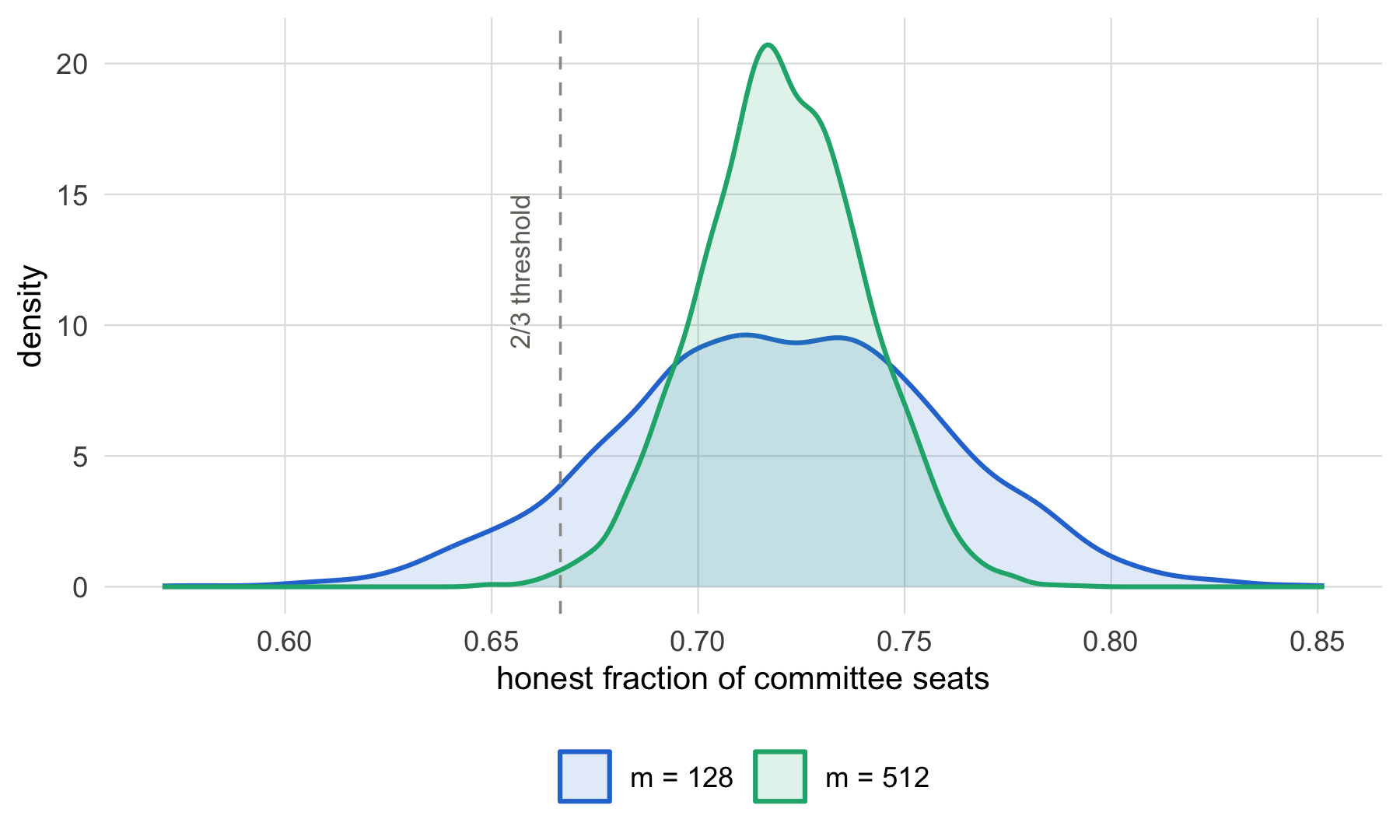
The rate is worth seeing rather than only asserting. Figure 10.2 draws the sampling distribution of the honest seat share for two committee sizes on a SYNTHETIC validator set. The larger committee concentrates visibly harder, and the mass below the two-thirds threshold, the region in which consensus is unsafe, shrinks sharply as the committee grows.
set.seed(512)n_val<-5000# SYNTHETIC: heavy-tailed stakes; honest fraction set near threshold.stake_c<-rlnorm(n_val, meanlog =0, sdlog =1)stake_c<-stake_c/sum(stake_c)pi_h<-0.72ord_c<-sample(n_val)cum_c<-cumsum(stake_c[ord_c])is_h<-logical(n_val)is_h[ord_c[cum_c<=pi_h]]<-TRUEdraw_share<-function(m){mean(is_h[sample(n_val, m, replace =TRUE, prob =stake_c)])}conc<-tibble::tibble( share =c(replicate(4000, draw_share(128)),replicate(4000, draw_share(512))), committee =rep(c('m = 128', 'm = 512'), each =4000))ggplot(conc, aes(share, colour =committee, fill =committee))+geom_density(alpha =0.14, linewidth =0.7)+geom_vline(xintercept =2/3, linetype ='dashed', colour ='#9a9a92', linewidth =0.4)+annotate('text', x =2/3-0.006, y =15, label ='2/3 threshold', colour ='#6f6f68', size =2.9, hjust =1, vjust =-0.3, angle =90)+scale_colour_manual(values =PAL[1:2])+scale_fill_manual(values =PAL[1:2])+labs(x ='honest fraction of committee seats', y ='density', colour =NULL, fill =NULL)+book_theme
Figure 10.2: A larger committee is a tighter estimator of the honest stake share, so the chance of drawing a committee below the two-thirds safety threshold falls sharply as the size grows from 128 to 512 seats. The honest fraction is held near seventy-two percent, close to the threshold, to keep the shrinking unsafe tail visible; under a realistic honest majority it is far smaller.
NoteCheck your understanding: why does committee size, not validator-set size, drive the guarantee?
The Hoeffding bound \(2\exp(-2 m t^2)\) depends on the committee size \(m\) but not on the total number of validators \(N\). Why is the representativeness of a sampled committee governed by \(m\) alone, and what does this imply for scaling the validator set?
Each committee seat is an independent draw from the population stake distribution, so the committee’s honest share is an average of \(m\) independent Bernoulli(\(\pi\)) variables whose concentration rate is set by \(m\). The population size \(N\) affects the granularity of the distribution being sampled but not the sampling error of an \(m\)-seat draw (with replacement, or with negligible finite-population correction when \(N \gg m\)). The practical implication is favourable: a protocol can admit an arbitrarily large validator set for decentralisation and Sybil resistance while keeping per-slot communication fixed, because a committee of a few hundred already delivers exponentially small misrepresentation probability regardless of how many validators exist in total.
10.7.1 Metastable consensus: Avalanche as repeated sampling
We include the present subsection on the strength of its statistical fit rather than its deployment prominence, and the reader should know as much at the outset. The committee protocols of the preceding section, whether the stake-weighted lottery of Ouroboros (Kiayias et al., 2017) or the cryptographic sortition of Algorand, the proof-of-stake protocol of Gilad and colleagues (Gilad et al., 2017) that draws its committee by a verifiable random function, draw one representative sample and let it vote. The Avalanche family, proposed by Rocket and colleagues (Rocket et al., 2019), reaches agreement by a different device entirely, and it is a device a sampling statistician will find familiar. But how does a node decide what the network prefers without a committee and without a tally? It samples, repeatedly. Each node polls a small random sample of its peers for their current preference, adopts the majority answer of that sample, and repeats, accumulating confidence over many such rounds until it commits. There is no leader and no global vote; there is only a node, a small poll, and a rule for updating on what the poll returns.
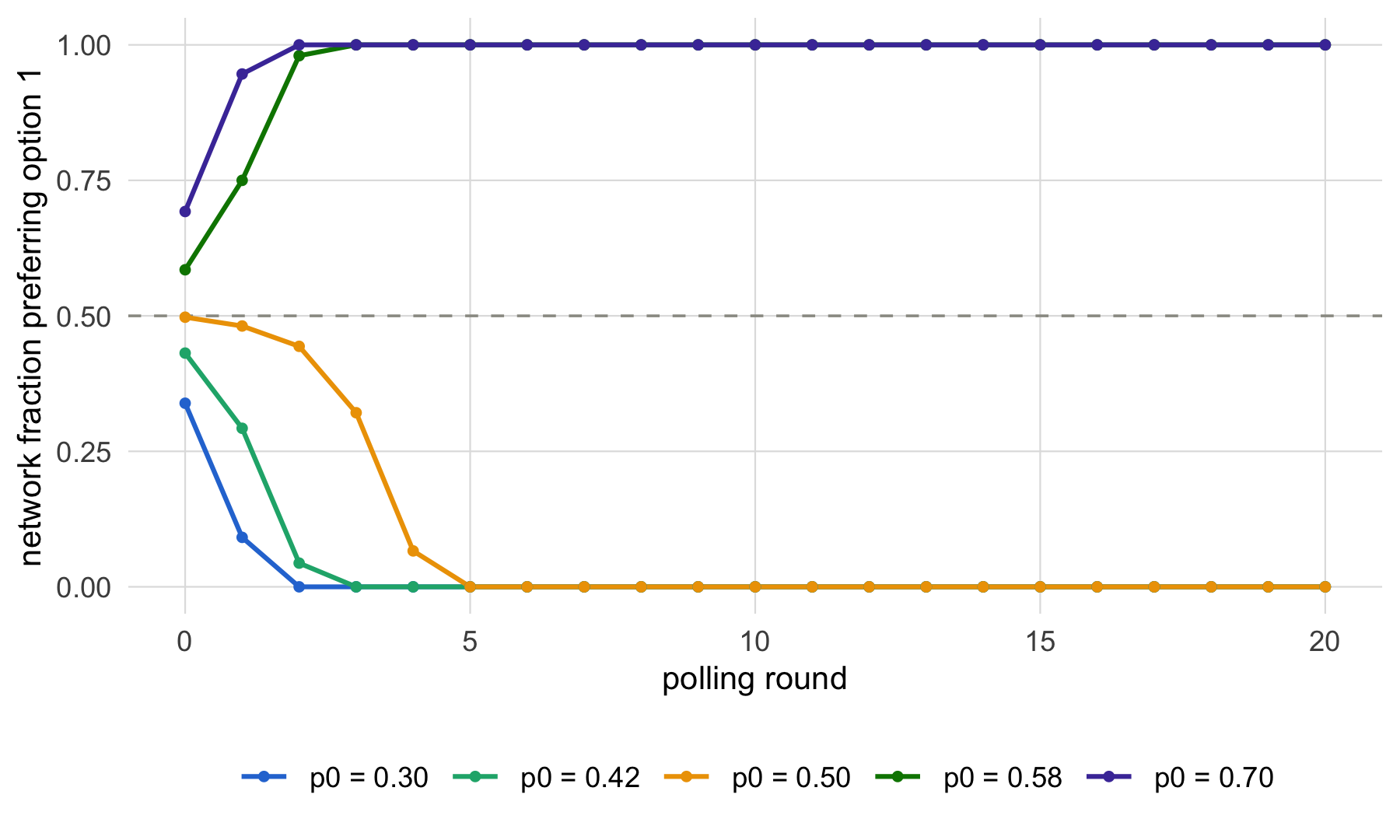
The statistical content is worth making explicit, and it is worth being precise about which urn model applies, since the obvious one is the wrong one. The process is a reinforcement scheme in which each round’s majority makes that majority more likely to be drawn in the next, so an initial lead is amplified rather than averaged away. It is tempting to call this a Polya urn, but the classical linear Polya urn does the opposite of what we need: its proportion is a bounded martingale that converges to a random, strictly interior limit, and it never locks to zero or one. The amplification to a near-unanimous absorbing state (a configuration the process cannot leave once it has entered it) is instead the behaviour of a nonlinear, super-linear reinforcement urn, or equivalently of a biased majority (voter) dynamic, in which feedback stronger than linear creates a tipping point and two absorbing states rather than a continuum of random limits. Equivalently, and more familiarly to an epidemiologist, it is a contagion process on the peer graph, in which a preference spreads from node to node by contact and a majority past a threshold sweeps the network. A biostatistician will recognise the super-linear reinforcement and an epidemiologist the contagion framing at once. The contrast with the preceding section is clean: both are sampling designs, but sortition draws a single committee meant to represent the whole, whereas Avalanche iterates many small polls to drive a reinforcement process to a metastable, near-unanimous absorbing state (a state that, once reached, persists indefinitely absent a large perturbation) with high probability. Figure 10.3 shows the reinforcement at work on a SYNTHETIC peer network, with several trajectories started from different initial fractions.
Figure 10.3: SYNTHETIC. Several repeated-subsampling trajectories of the network fraction preferring one option, over polling rounds, on a small peer network. Preferences starting below the one-half tipping fraction die out toward zero, while those above it sweep to near-unanimity, the two metastable absorbing states. The same threshold behaviour is the epidemic threshold of infectious-disease models in another costume.
We should be even-handed about what this device buys and what it costs. On the plus side, repeated subsampling gives fast, leaderless agreement with high probability, and it does so without the communication burden of collecting every validator’s vote. On the minus side, the guarantee is probabilistic rather than classically final: the process settles into its absorbing state with high probability, not with the accountable certainty of a slashing bound, and the whole security argument rests on sampling assumptions, an honest supermajority among the polled and an unbiased draw of peers, that merit exactly the scrutiny this chapter has applied elsewhere. A biased sample or a dishonest supermajority breaks the amplification in the adversary’s favour, and neither assumption verifies itself.
The contagion framing is not a loose metaphor. The mathematics of preference spread here is the mathematics of epidemic spread the reader may know from infectious-disease modelling, and the threshold behaviour is the same in both: a preference held below a tipping fraction dies out, while one above it sweeps the network, which is the epidemic threshold in another costume, below the critical reproduction number an outbreak fizzles and above it takes off. The analogy has a limit worth marking, however. In a natural epidemic the transmission rule is fixed by biology and the modeller only observes it, whereas in Avalanche the designer chooses the sampling rule, the sample size, and the decision threshold, and so can engineer the tipping fraction and the speed of convergence rather than merely estimate them.
NoteCheck your understanding: why does an initial majority sweep the network?
In Avalanche’s repeated subsampling each node adopts the majority preference of a small random poll every round. If a preference already holds a modest majority of the network, why does repeated polling drive it toward near-unanimity rather than back toward the fifty-fifty split, and what feature of the dynamics makes the two extremes absorbing?
The poll is drawn from the current population, so a preference held by a majority is more likely than not to be the majority of any given sample, and each node that adopts it enlarges the majority faced by the next. This is super-linear reinforcement, the majority-amplifying feedback of a biased voter dynamic rather than the mean-reverting draw of a classical linear urn: success breeds success, and the lead compounds rather than reverting to the mean. The fifty-fifty split is an unstable equilibrium, since any chance departure from it is amplified, while near-unanimity is stable, because a sample from a near-unanimous population almost surely returns the same answer and no node changes its mind. The two extremes are therefore absorbing, and which one the process reaches is decided by which side of the tipping fraction the initial preference lies on, exactly as an epidemic’s fate is decided by whether transmission sits above or below its threshold.
10.8 Worked example: restaking as correlated liquidation
Restaking, set out in the whitepaper of EigenLayer, the protocol that introduced the practice to Ethereum (EigenLayer Team, 2023), lets capital already bonded to secure the base chain be rehypothecated to secure additional services, called actively validated services (AVSs). Each additional service carries its own slashing conditions, so the same bond is now exposed to slashing from several sources at once. Marketed as extra yield on idle-looking collateral, it is, in the language the reader already owns, leverage: one unit of capital backing several liabilities. It is also, and more usefully for us, the reinsurer’s situation exactly, one reserve written against many policies that may or may not fail together, and leverage together with a shared shock is a correlated-liquidation problem.
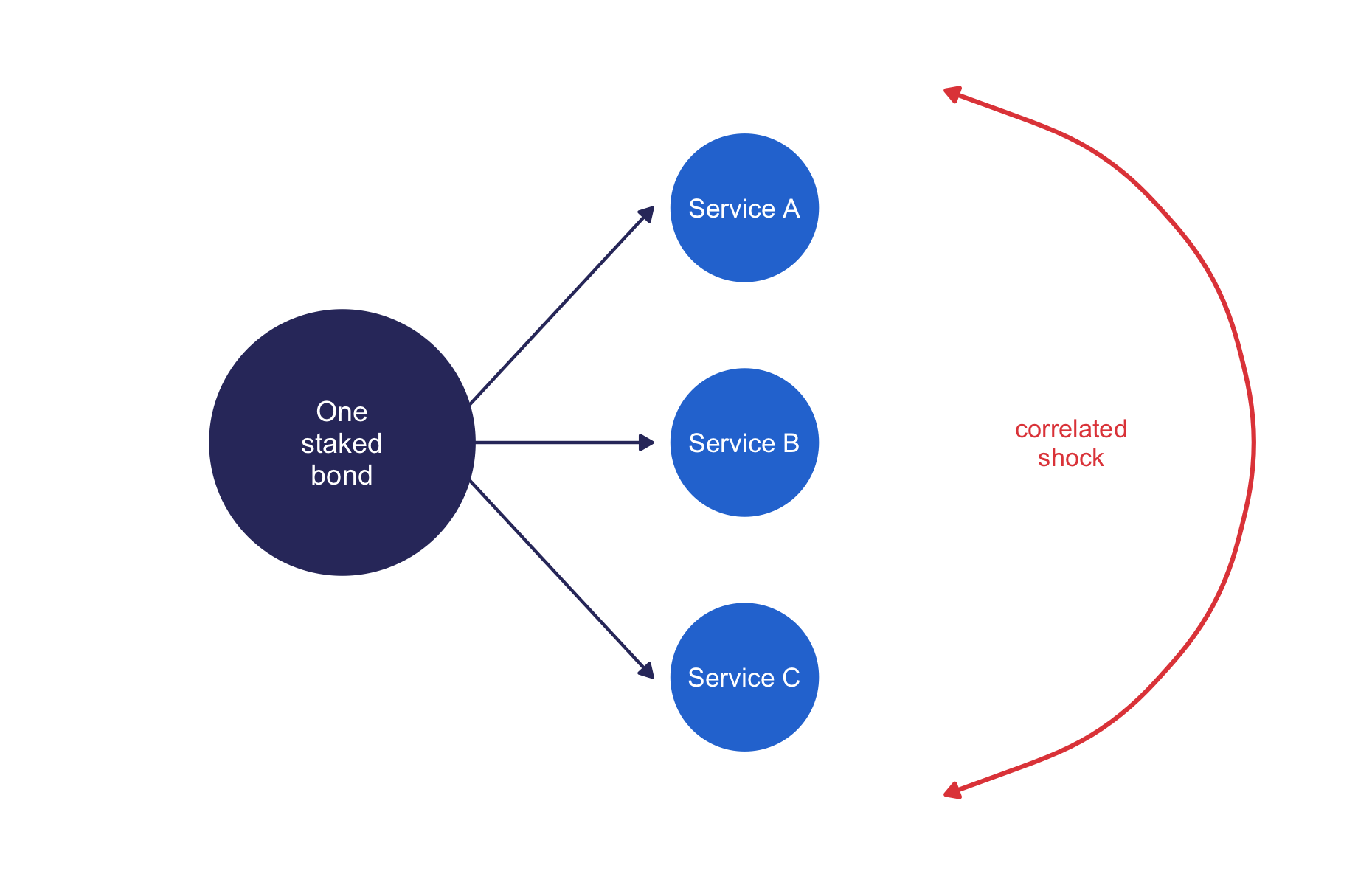
The shape of the exposure is worth drawing. Figure 10.4 places one bonded pool at the centre, rehypothecated outward to secure several services at once, and a single correlated shock that can strike all of them together. The arrows outward are the leverage; the red arc is the dependence the yield calculation never mentions.
pool<-tibble::tibble(x =0, y =0, label ='One\nstaked\nbond')svc<-tibble::tibble( x =c(2.4, 2.4, 2.4), y =c(1.4, 0, -1.4), label =c('Service A', 'Service B', 'Service C'))spokes<-tibble::tibble( x =0.55, y =0, xend =svc$x-0.55, yend =svc$y)ggplot()+geom_segment(data =spokes,aes(x =x, y =y, xend =xend, yend =yend), arrow =arrow(length =unit(0.16, 'cm'), type ='closed'), colour ='#33356b', linewidth =0.5)+annotate('curve', x =3.6, y =2.1, xend =3.6, yend =-2.1, curvature =-0.9, colour ='#e34948', linewidth =0.7, arrow =arrow(length =unit(0.16, 'cm'), ends ='both', type ='closed'))+annotate('text', x =4.35, y =0, label ='correlated\nshock', colour ='#e34948', size =2.9, lineheight =0.95)+geom_point(data =svc, aes(x, y), size =22, shape =21, fill ='#2a78d6', colour ='#2a78d6')+geom_text(data =svc, aes(x, y, label =label), colour ='white', size =3.0)+geom_point(data =pool, aes(x, y), size =40, shape =21, fill ='#33356b', colour ='#33356b')+geom_text(data =pool, aes(x, y, label =label), colour ='white', size =3.2, lineheight =0.95)+coord_equal(xlim =c(-1.1, 5.2), ylim =c(-2.4, 2.4))+theme_void()
Figure 10.4: Restaking rehypothecates one bonded pool to secure several services at once, so a single correlated shock can slash the same capital from several directions together. It is the situation of a reinsurer: one reserve written against many liabilities that may fail together.
The systemic risk is not the marginal slashing probability of any one service; we may fix that at a modest level and set it aside. The risk lives in the joint tail, the probability that many services slash the same bond in the same event. Whether that tail is thin or fat is governed entirely by the correlation between slashing events, a parameter the yield calculation omits. We model it with a Gaussian copula, the same instrument by which a reinsurer binds a set of marginal failure probabilities to a dependence structure, drawing correlated latent normals via a Cholesky factorisation (and so avoiding a MASS dependency), and we read a service as slashing when its latent variable falls below the threshold implied by its marginal slashing probability. The code is reused verbatim from the verified companion.
library(tibble)# Cholesky-based correlated normal draws, so no MASS dependency.rmvn<-function(n, Sigma){matrix(rnorm(n*ncol(Sigma)), n)%*%chol(Sigma)}set.seed(9)simulate_restaking_loss<-function(n_services=10, rho=0.0,p_slash=0.05, sims=5000){Sigma<-matrix(rho, n_services, n_services)diag(Sigma)<-1z<-rmvn(sims, Sigma)thresh<-qnorm(p_slash)slashed<-z<threshrowSums(slashed)/n_services}loss_indep<-simulate_restaking_loss(rho =0.0)loss_corr<-simulate_restaking_loss(rho =0.7)tibble( scenario =c('independent', 'correlated (rho=0.7)'), mean_loss =c(mean(loss_indep), mean(loss_corr)), p_loss_over_30pct =c(mean(loss_indep>0.3), mean(loss_corr>0.3)))#> # A tibble: 2 × 3#> scenario mean_loss p_loss_over_30pct#> <chr> <dbl> <dbl>#> 1 independent 0.0500 0.001 #> 2 correlated (rho=0.7) 0.0489 0.0452
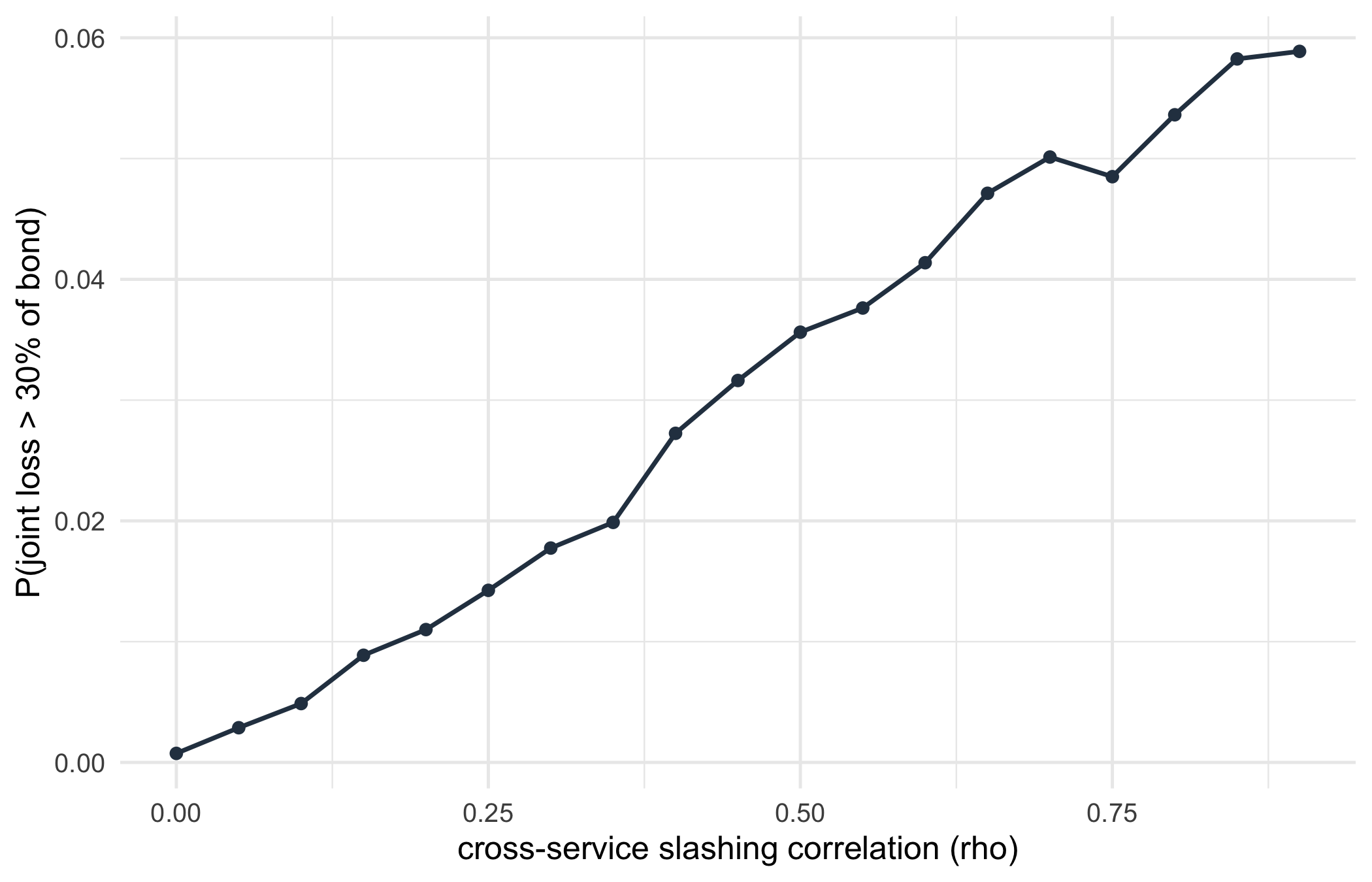
The two scenarios are calibrated to the same marginal slashing probability and therefore the same mean loss. They differ only in correlation, and that difference is the entire story of the tail. Under independence a joint loss exceeding thirty percent of the bond is vanishingly rare, because it requires many independent low-probability events to coincide. At correlation \(\rho = 0.7\) the same large loss becomes orders of magnitude more likely, because a single common shock can trip many services together. Two portfolios with identical expected loss can have tail-loss probabilities that differ by an order of magnitude; correlation, not the marginal, is what prices the disaster. This is precisely what every reinsurer knows and what the yield brochure omits: at a fixed mean, correlation moves risk into the tail.
The point is worth seeing as a curve rather than as two scenarios. Figure 10.5 traces the probability of a joint loss exceeding thirty percent of the bond as the cross-service correlation is swept from zero to nine tenths, with the marginal slashing probability held fixed throughout.
library(ggplot2)set.seed(94)rho_grid<-seq(0, 0.9, by =0.05)p_tail<-vapply(rho_grid, function(r){mean(simulate_restaking_loss(rho =r, sims =8000)>0.3)}, numeric(1))tail_curve<-tibble::tibble(rho =rho_grid, p_tail =p_tail)ggplot(tail_curve, aes(rho, p_tail))+geom_line(linewidth =0.8, colour ='#2c3e50')+geom_point(size =1.6, colour ='#2c3e50')+labs(x ='cross-service slashing correlation (rho)', y ='P(joint loss > 30% of bond)')+theme_minimal(base_size =12)
Figure 10.5: SYNTHETIC. Probability that restaking’s joint slashing loss exceeds thirty percent of the bond, as the cross-service slashing correlation rises, at a fixed marginal slashing probability of 0.05. Because the marginal is held fixed, the mean loss is unchanged along the curve; only the tail moves. A multi-site trial exhibits the same shape when a shared frailty couples site-level dropout: the marginal dropout rate is unmoved, but the variance of any aggregate estimate thickens with correlation.
ImportantThe sceptic’s reflex: ‘restaking is free extra yield’
The phrase ‘extra yield with no additional risk’ delivers a narrative (tier four) in the cadence of a protocol fact. Restaking adds risk; it merely moves that risk into the joint tail, where a mean-and-yield summary cannot see it. The correct restatement is a tier-three claim with an explicit parameter: the extra yield compensates for a correlated slashing exposure whose severity is governed by the cross-service correlation \(\rho\), and the yield is fairly priced only if it exceeds the expected tail loss at the true\(\rho\), which is almost never measured. Demote ‘free yield’ to ‘a short position in a correlated tail’, and ask who is estimating the correlation.
10.8.1 The public-health connection
The correlated-loss object is not blockchain-specific. It is the same statistical structure we confront as correlated censoring or dropout in a clinical trial, and as shared-frailty failure in a survival model. In a multi-site trial, an analysis that treats participant dropout as independent across sites will badly understate the variance of any aggregate estimate when a common cause, a protocol amendment, a supply interruption, a regional event, makes many participants leave together. The failure mode is identical to restaking’s: a summary calibrated on the marginals is blind to a tail generated by a shared shock. A shared-frailty model, in which a latent common factor couples individual hazards, is structurally the same device as the Gaussian copula above, with the frailty playing the role of the common latent normal, and both are the reinsurer’s device deployed for the same reason.
The transferable lesson, we would suggest, is that a statistician trained to distrust independence assumptions in survival and longitudinal data is precisely the person who should price restaking’s systemic risk. The tail that the yield-focused literature ignores is the tail that correlated-dropout methodology exists to quantify. Where a restaked service secures on-chain records on which a health system relies, the provenance of a vaccine cold chain, say, or the enrolment log of the trial ledger, the correlated-liquidation risk of the securing capital becomes a data-integrity risk for the health application, and the same correlation analysis governs both.
We should be candid, finally, about the negative result of Chapter 1. If a single custodian can be trusted to keep the record, none of this machinery is needed, and a database with an audit log is the correct tool. For the trial ledger, which is a consortium of named and contractually accountable hospitals rather than an open set of anonymous bonders, the analogue of slashing is not the destruction of a posted bond but a contractual and reputational penalty. That is proof-of-stake’s logic, the deterrence of misbehaviour by a credible loss, without proof-of-stake’s machinery, and where a regulator can impose the penalty by contract it is the cheaper instrument.
10.9 Collaborating with an LLM
An assistant is useful for drafting protocol summaries and simulation scaffolding, but the load-bearing judgements here are exactly the ones an assistant will paper over. We offer three prompt-and-verification triples.
Prompt. ‘Explain why reverting a finalised Ethereum block costs at least one third of total stake.’
Watch for: a fluent restatement that omits the overlap argument, or that conflates ‘one third slashed’ with ‘one third needed to attack liveness’. The safety bound (one-third overlap of two two-thirds supermajorities) and the liveness bound are different quantities.
Verification: the reader should reconstruct the counting argument independently. Two sets each exceeding \(2/3\) of stake overlap in more than \(1/3\); confirm the assistant’s explanation reduces to this and cites the slashing conditions (Buterin & Griffith, 2017).
Prompt. ‘Write R to show that restaking increases risk as correlation rises.’
Watch for: code that changes the marginal slashing probability along with the correlation, which confounds the two effects and makes the demonstration meaningless. Also watch for a multivariate-normal call pulling in an unnecessary package dependency.
Verification: confirm the mean loss is held fixed across correlation levels (as in ch09-restaking), so that only the tail moves. Check that the copula is correctly specified: the threshold must be \(\Phi^{-1}(p_\text{slash})\) for the target marginal.
Prompt. ‘Is a small validator committee safe as a stand-in for the whole set?’
Watch for: an appeal to ‘randomness’ or ‘large numbers’ with no rate. Safety here is a concentration bound, and a claim without a bound is not an answer.
Verification: demand the Hoeffding or Chernoff inequality and its dependence on committee size \(m\), and sanity-check it against a simulation like ch09-sortition.
10.10 In conclusion
In conclusion, three points are to be emphasised. First, the security of a proof-of-stake ledger is a cost-of-attack inequality and nothing more mysterious: the cost is capital placed at risk of slashing, and the accountable-safety bound fixes its floor at roughly one third of the total stake, a figure the analyst should state precisely, with its assumptions, rather than borrow as folklore. Second, committee sortition is probability-proportional-to-size sampling, so a committee’s fidelity to the validator set is a concentration inequality of exactly the kind that licenses a well-designed survey sample; the governing quantity is the committee size, not the size of the validator set, and the guarantee should be quoted as a tail bound and never as a promise. Third, restaking is leverage, and its danger lives entirely in the joint tail: at a fixed marginal slashing probability, correlation moves the risk into the tail exactly as it does for a reinsurer, or for a multi-site trial with a shared frailty, and the statistician trained to distrust independence assumptions is the right person to price it. For the trial ledger itself we would add, in the spirit of Chapter 1, that the honest conclusion is frequently that a permissioned consortium bound by contract achieves the same integrity as a bonded chain at a fraction of the cost, and the cost-of-attack calculation developed here is the instrument by which that judgement is made.
10.11 Exercises
Reconstruct accountable safety. Prove that if two conflicting checkpoints are each finalised under Casper FFG’s two-thirds rule, then validators holding at least one third of total stake have violated a slashing condition. State precisely where each of the two slashing conditions (no double vote, no surround vote) is used.
Committee concentration (quantitative). For an honest stake fraction \(\pi = 0.7\), use Hoeffding’s inequality to find the smallest committee size \(m\) guaranteeing that the probability a committee falls below the two-thirds honesty threshold is at most \(10^{-6}\). Then verify your \(m\) by simulation, adapting ch09-sortition, and comment on the gap between the bound and the empirical probability.
Cost-of-attack sensitivity (quantitative). Extend ch09-cost so that the proof-of-stake attacker can recover a fraction \(\gamma\) of the staked asset’s value by shorting it before the attack, and plot net attack cost against \(\gamma\). At what \(\gamma\) does the proof-of-stake attack become cheaper than the proof-of-work attack under the chapter’s illustrative parameters? Interpret the result as a statement about which assumption in the sceptic’s-reflex callout is doing the work.
Correlated-loss tail (quantitative). Using simulate_restaking_loss, plot the probability of a joint loss exceeding thirty percent as a function of correlation \(\rho \in [0, 0.9]\), holding the marginal slashing probability fixed at \(0.05\). Fit or describe the shape of the curve and identify the correlation at which the tail probability first exceeds one percent. Relate the curve to the shared-frailty analogy.
Provable versus economic security. Contrast the security guarantee of Ouroboros (Kiayias et al., 2017) with the economic cost-of-attack argument for a Casper-finalised chain. For each, state the threat model, the assumption, and what an adversary must control to break it. Which guarantee is falsifiable by which kind of evidence?
When restaking is the wrong tool. Identify a public-health data-integrity problem for which a restaked service could in principle provide trust-minimised verification, then argue whether the added correlated-liquidation risk is justified relative to a governed database with an audit log. Make the argument quantitative where you can.
10.12 Further reading
Buterin & Griffith (2017) is the primary source for Casper FFG. Read it for the two slashing conditions and the accountable-safety theorem; the counting argument behind the one-third bound is worth reconstructing on paper.
Buterin et al. (2020) specifies Gasper, the composition of LMD-GHOST fork choice with Casper finality, and states its safety and liveness properties in a partially synchronous model. It is the consensus core of proof-of-stake Ethereum.
Kiayias et al. (2017) is the foundational paper of the provably-secure proof-of-stake family. Read it for the style of guarantee: a formal reduction to honest-majority-of-stake under an explicit network and adversary model, in the tradition of
EigenLayer Team (2023) is the restaking whitepaper. Read it for the mechanism (rehypothecation of stake to secure AVSs) and read it adversarially for the correlation assumption its risk discussion leaves implicit.
Narayanan et al. (2016) remains the reference textbook for the surrounding consensus and security material, and its treatment of cost-of-attack reasoning is the baseline this chapter extends from proof-of-work to proof-of-stake.
Buterin, V., Hernandez, D., Kamphefner, T., Pham, K., Qiao, Z., Ryan, D., Sin, J., Wang, Y., & Zhang, Y. X. (2020). Combining GHOST and Casper. arXiv:2003.03052. https://arxiv.org/abs/2003.03052
Garay, J. A., Kiayias, A., & Leonardos, N. (2015). The Bitcoin backbone protocol: Analysis and applications. Advances in Cryptology — EUROCRYPT 2015, LNCS, 9057, 281–310. https://doi.org/10.1007/978-3-662-46803-6_10
Gilad, Y., Hemo, R., Micali, S., Vlachos, G., & Zeldovich, N. (2017). Algorand: Scaling Byzantine agreements for cryptocurrencies. 26th Symposium on Operating Systems Principles (SOSP), 51–68. https://doi.org/10.1145/3132747.3132757
Kiayias, A., Russell, A., David, B., & Oliynykov, R. (2017). Ouroboros: A provably secure proof-of-stake blockchain protocol. Advances in Cryptology — CRYPTO 2017, LNCS, 10401, 357–388. https://doi.org/10.1007/978-3-319-63688-7_12
Narayanan, A., Bonneau, J., Felten, E. W., Miller, A., & Goldfeder, S. (2016). Bitcoin and cryptocurrency technologies: A comprehensive introduction. Princeton University Press. https://bitcoinbook.cs.princeton.edu/
Pass, R., Seeman, L., & Shelat, A. (2017). Analysis of the blockchain protocol in asynchronous networks. Advances in Cryptology — EUROCRYPT 2017, LNCS, 10211, 643–673. https://doi.org/10.1007/978-3-319-56614-6_22
Rocket, T., Yin, M., Sekniqi, K., Renesse, R. van, & Sirer, E. G. (2019). Scalable and probabilistic leaderless BFT consensus through metastability. arXiv:1906.08936. https://arxiv.org/abs/1906.08936
Sompolinsky, Y., & Zohar, A. (2015). Secure high-rate transaction processing in Bitcoin. Financial Cryptography and Data Security (FC 2015), LNCS, 8975, 507–527. https://doi.org/10.1007/978-3-662-47854-7_32